
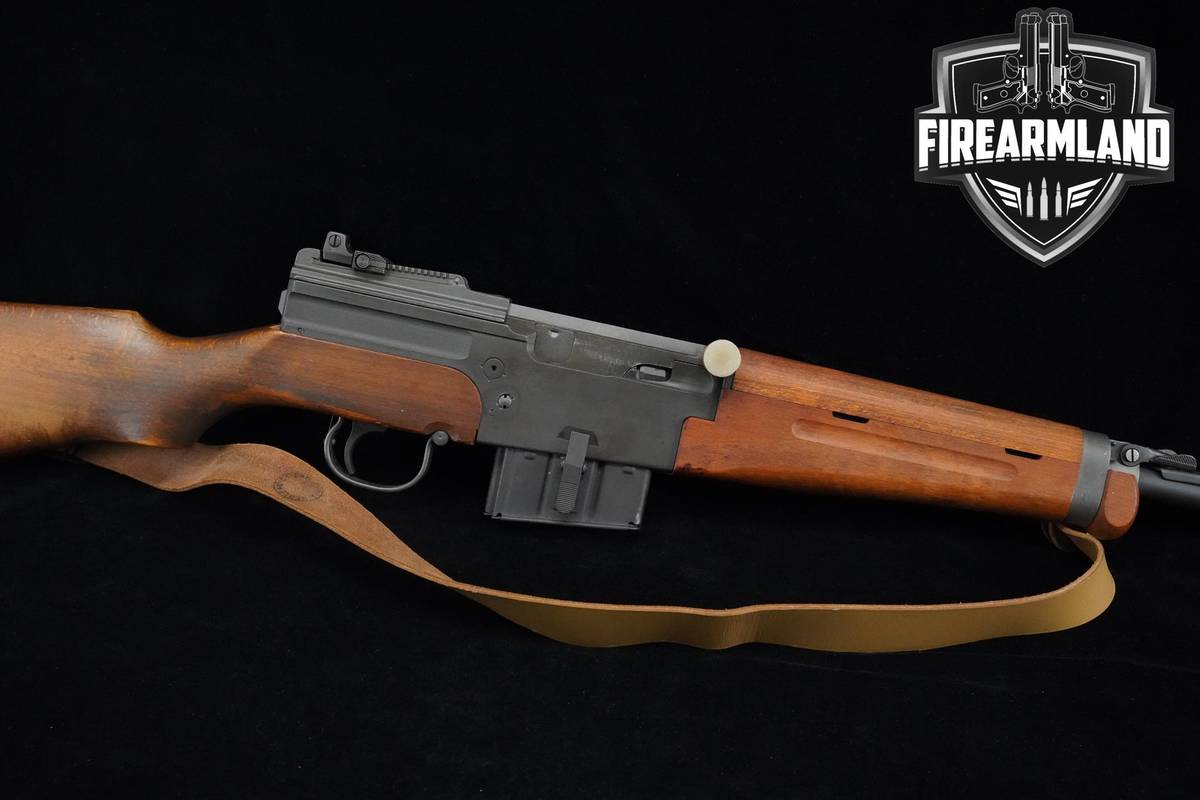
MAS 49/56 7.5x54mm French Semi-Automatic Rifle – Early G-Prefix Production with Grenade Launcher & Scope Rail
Built at Manufacture d’Armes de Saint-Étienne between 1958 and 1960, this Modèle 1949/56 represents the first “G-block” rifles released as France phased down Algerian War deployments. It remains in very good, arsenal-refinished condition and retains its original 22 mm muzzle brake/grenade launcher, integral left-side scope rail, and matching 10-round steel magazine—features that make this rifle a standout for collectors of Cold War small arms.
Condition
Overall Condition: Very good condition, showing only light, superficial signs of prior handling or use.
Bore Condition: Good - Clean, well-maintained, minor wear marks.
Bore Rifling: Good Rifling - Intact, well-defined lands and grooves.
Specific Condition Notes: Minor scratching, scuffing, and blemishing are present on the metal and stock surfaces.
What’s Included
- MAS 49/56 rifle
- 1× 10-round steel magazine (installed)
- French issue tan leather sling (installed)
Manufactured during the sought-after G-prefix run, this rifle was among the earliest 49/56 examples to incorporate France’s shift toward lighter, more versatile infantry arms. The “G 50521” serial block aligns with 1958–1960 production, giving it historical relevance to the closing phase of French operations in North Africa.
The MAS 49/56 fires the 7.5×54 mm French cartridge from a 10-round detachable magazine and uses a direct-impingement gas tube—an approach adopted years before the U.S. AR-15 platform popularized the concept. This design keeps moving parts to a minimum while delivering reliable semi-automatic function.
An integral 22 mm ported muzzle brake doubles as a NATO-pattern grenade launcher, and the rifle retains its flip-up grenade ladder sight. This factory configuration embodied France’s doctrine of giving every rifleman immediate anti-armor capability without additional launchers.
The forged steel receiver carries a left-side scope rail that accepted the APX L806 optic, offering a forward-thinking “optics-ready” solution decades ahead of common Western practice. Paired with a tangent rear aperture (200–1200 m drum) and hooded front post, the sighting system supports both precision and field use.
A boxed “P72” refurb mark confirms a 1972 arsenal inspection—typical of rifles later released to surplus—while the gray manganese phosphate finish, beech hardwood furniture, and solid buttstock preserve the rifle’s Cold War aesthetic.