
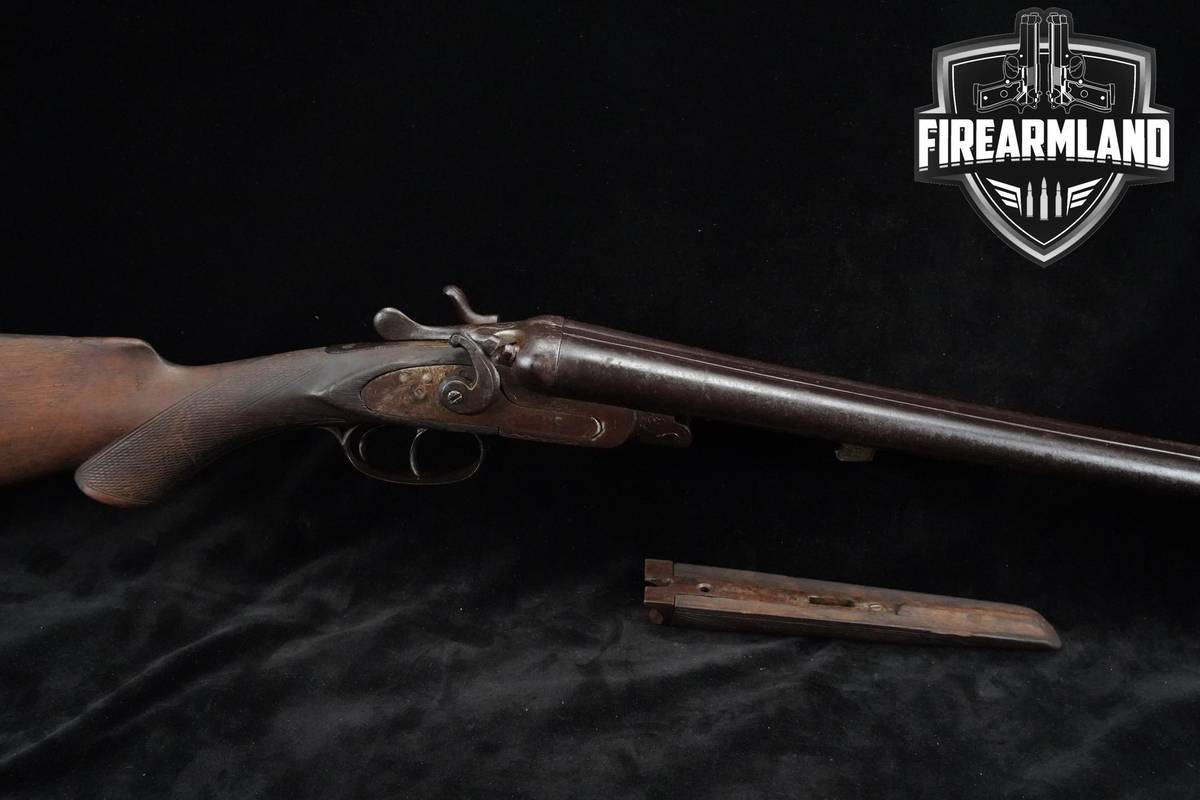
T. Barker 12 Gauge Side-by-Side Damascus Shotgun, 32-Inch Barrels, Belgian Antique
This late-19th-century T. Barker side-by-side combines classic Belgian trade craftsmanship with 32-inch laminated steel barrels and Jones-style rotary under-lever lock-up. External rabbit-ear hammers, double triggers, and simple scroll engraving mark it as a working gun of the 1880s–1890s, while the Crown/ELG oval proof attests to Liège origin. Its early 70 mm (2.75 in) chambers and skelp-twist Damascus tubes make it a notable example for collectors focused on transitional European shotguns.
Condition
Overall Condition: Poor condition.
Bore Condition: Fair – Generally clean, some residue or smudges, slight corrosion.
Bore Fouling: Moderate fouling – Lead or copper fouling with noticeable buildup.
Specific Condition Notes: The forend retaining latch is broken, preventing the forend from locking to the barrels. Both external hammers show damage to the rabbit-ear spurs. Moderate scratching, scuffing, pitting, and blemishing are present on metal surfaces, and the bores display moderate pitting.
What’s Included
- T. Barker 12 Gauge side-by-side shotgun
The 32-inch laminated Damascus barrels exhibit a pronounced skelp twist pattern and retain a browned finish. A passive extractor setup simplifies operation while maintaining period authenticity.
The Jones-style rotary under-lever with dolls-head extension provides a robust lock-up typical of quality Belgian exports of the era. External hammers and double triggers offer the traditional control layout favored by Victorian-period sportsmen.
Simple border and scroll engraving adorns the lock plates, fences, dolls-head, and trigger guard, all now wearing a patinated color case-hardened finish that reflects decades of age.
The walnut stock features 18 lpi border checkering on a semi-pistol grip and a matching splinter forend. Length of pull measures 13.5 inches, consistent with late-19th-century dimensions.
Liège Crown/ELG proof marks and the absence of a serial number align with Belgian trade-name production, while the 70 mm chamber marking illustrates early adoption of the modern 2.75-inch shell length.