
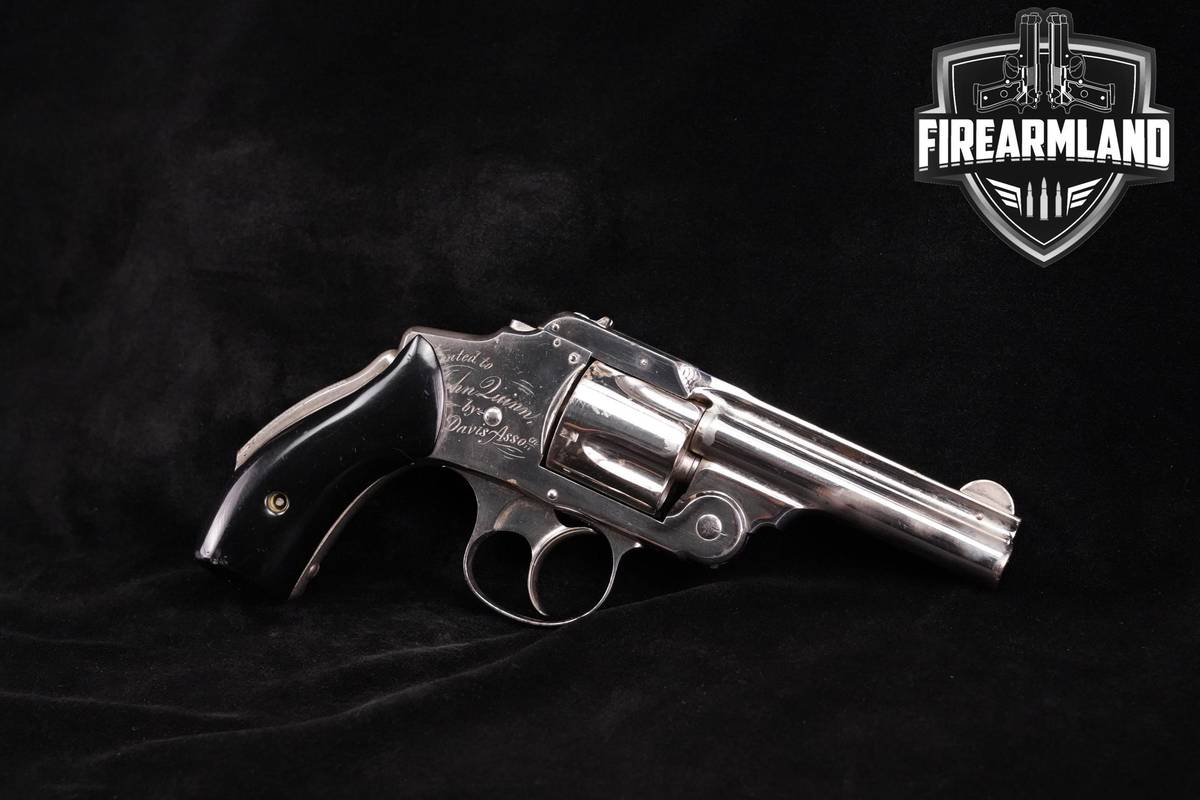
Smith & Wesson .38 Safety Hammerless 2nd Model Nickel, Presentation-Engraved, 3.5" Top-Break Revolver
This antique Smith & Wesson .38 Safety Hammerless 2nd Model stands out for its factory nickel finish, early “Lemon Squeezer” grip-safety design, and presentation engraving reading “Presented to John Quinn by Davis Asso…”. Produced in the 1880s and falling well within the pre-1899 serial range, it combines collectible provenance with the distinctive top-break, simultaneous-extraction system that defined the model.
Condition
Overall Condition: Fair condition, showing extensive signs of prior use and handling.
Bore Condition: Fair – Generally clean, some residue or smudges, slight corrosion.
Bore Rifling: Fair Rifling – Worn rifling, slight loss of definition.
Specific Condition Notes: The barrel shows noticeable marks and blemishes.
What’s Included
- Smith & Wesson .38 Safety Hammerless 2nd Model revolver
The 2nd Model retains the push-button latch and internal hammer that distinguish it from the 1st Model, delivering reliable double-action-only operation with no external hammer spur to snag. The nickel plating remains present on the carbon-steel frame, cylinder, and barrel, complementing the crisp presentation script on the side-plate.
Its 3.5-inch barrel, five-shot cylinder chambered in .38 S&W, and simultaneous extractor illustrate Smith & Wesson’s practical approach to personal-defense revolvers of the era. The half-moon front blade and rear notch in the latch provide the simple, durable sight picture expected of a period carry gun.
The smooth black replacement grip panels maintain the original contour while contrasting with the nickel finish and preserving the grip-safety function. The smooth trigger face and internal hammer complete the streamlined profile popularly nicknamed the “Safety Hammerless”.
Collectors will appreciate its verified antique status, the early serial within 2nd Model production, and the added historical interest of the personalized engraving. As an engraved, presentation-grade example, it offers both display value and insight into late-19th-century gift-giving practices among professionals and associations.