
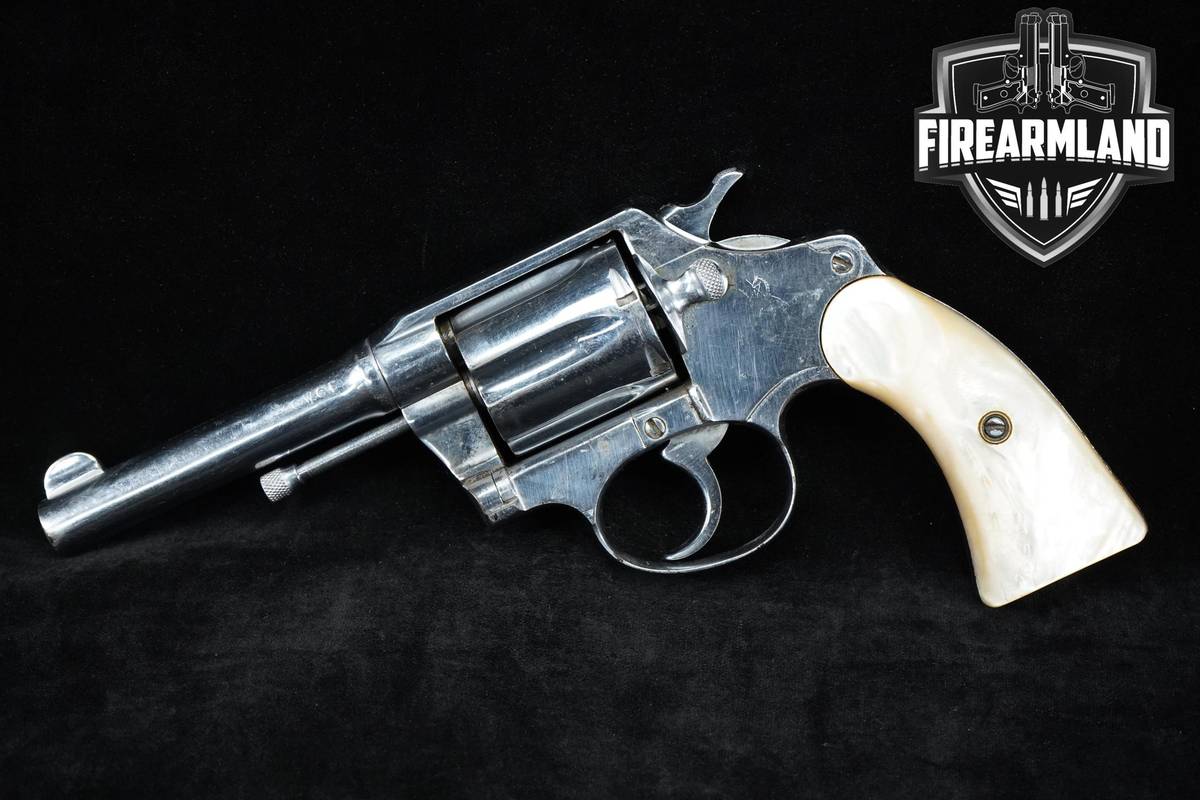
Colt Police Positive Special First Issue .32-20 Win., Bright Nickel, 4-Inch Barrel, 1929 Production
This First Issue Colt Police Positive Special stands out with its bright factory nickel finish, uncommon .32-20 Winchester chambering, and aftermarket mother-of-pearl-style grips. Manufactured in 1929 on Colt’s compact D-frame, it combines early 20th-century law-enforcement heritage with eye-catching custom touches that distinguish it from the more common blue-finished, .38-caliber examples.
Condition
Overall Condition: Fair. The revolver shows extensive evidence of prior use and handling. Nickel plating displays widespread blemishes, finish wear, scratching, and scattered areas of surface rust.
Bore Condition: Fair. Bore is generally clean with minor residue and slight corrosion. Rifling remains well-defined and serviceable.
What’s Included
- Colt Police Positive Special First Issue revolver with 4-inch barrel
- Aftermarket mother-of-pearl-style grip panels (installed)
Colt introduced the Police Positive Special in 1908 as an upgrade to the original Police Positive, lengthening the cylinder to accommodate cartridges such as the .32-20 Winchester. This example retains hallmark First Issue traits, including the smooth top strap, un-shrouded ejector rod, and fluted six-shot cylinder.
The revolver’s bright nickel finish was a factory option that provided a high-visibility surface favored by some officers and civilians alike. While the finish now shows wear, it still presents a classic mirror-like sheen characteristic of Colt’s 1920s nickel work.
Chambered in .32-20 Win., this Colt offers a less common caliber for the model, adding collector interest. The cartridge’s tapered case seats well in the revolver’s 4-inch barrel, a length that balances handling and ballistic performance.
Custom mother-of-pearl-style grips replace the factory hard-rubber panels, giving the revolver a distinctive appearance without altering factory dimensions. Beneath the grips lies Colt’s Positive Lock hammer-block safety, a proven design that prevents the hammer from contacting the firing pin unless the trigger is fully depressed.
Serial number 268xxx places production firmly in 1929, right in the heart of the First Issue era, before later engineering changes such as the heavy barrel and shrouded ejector rod were introduced.