
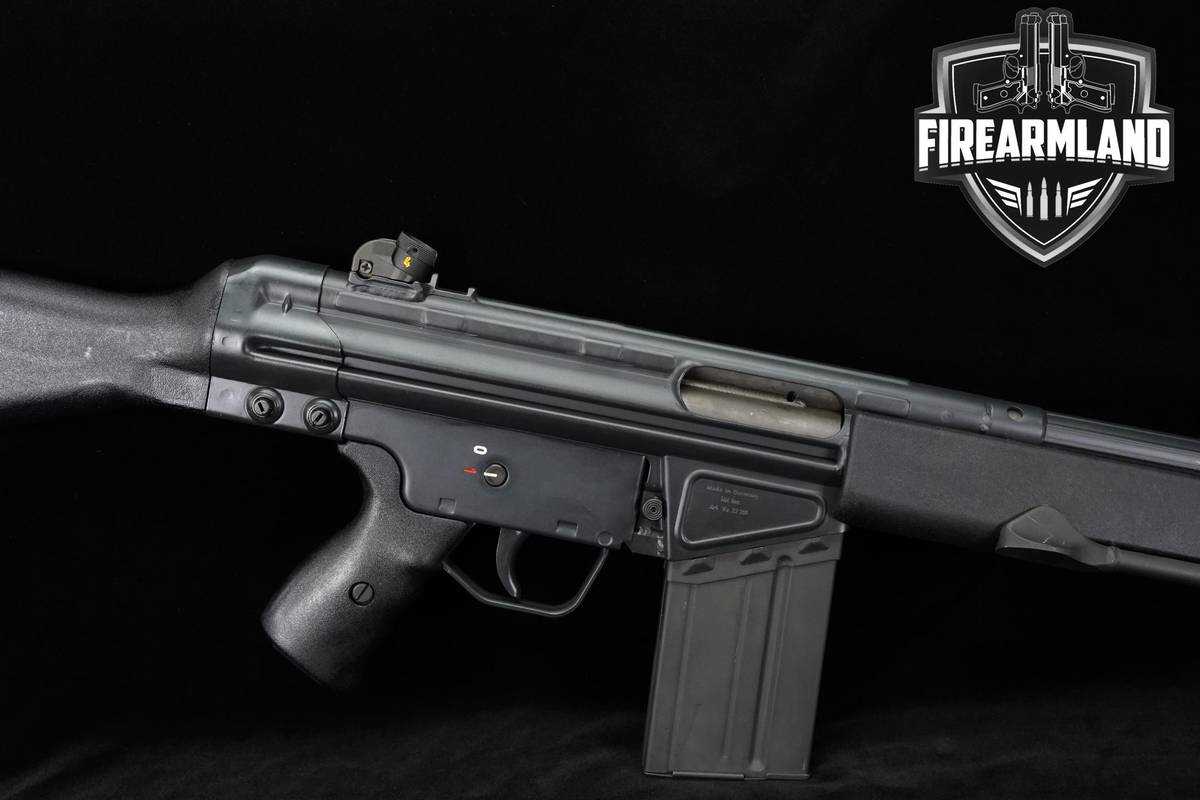
Pre-Ban 1981 Heckler & Koch HK91 A2 7.62×51 Roller-Delayed Rifle, West German Made
This HK91 A2 is a true West German pre-ban import, produced in 1981 and built on the same Oberndorf line as the G3A3 service rifle. Chambered in 7.62×51 NATO, it features the proven roller-delayed blowback system, a cold-hammer-forged barrel, and H&K’s distinctive gray-green enamel finish. With its date-coded receiver, original prong flash suppressor, and limited import numbers before the 1989 ban, this example offers genuine collector appeal while remaining a practical, battle-tested semi-auto rifle.
Condition
Overall Condition: Very good condition, showing only light, superficial signs of prior handling or use.
Bore Condition: Excellent - Clean, mirror finish, no signs of wear.
Bore Rifling: Excellent Rifling - Sharp lands and grooves.
Specific Condition Notes: The exterior shows a few minor surface scratches and small blemishes consistent with careful use. The bore remains bright and sharp, reflecting minimal firing.
What’s Included
- Stamped-steel 20-round HK91/G3 pattern magazine
Produced in 1981, the receiver bears the “IB” date code and West German eagle/N proof, confirming authentic factory origin before U.S. import restrictions. The import mark reads “Made in Germany / H&K Inc. / Arl. Va.
22 201,” matching early H&K Inc. documentation.
The 17.5-inch chrome-moly barrel is cold-hammer-forged for durability and accuracy. It is threaded 15×1 RH and fitted with H&K’s 22 mm prong flash suppressor, which also accepts NATO-spec rifle grenades.
Classic H&K furniture completes the package: a fixed polymer stock with 14.5-inch length of pull, a slim black polymer forend, and a folding charging handle. The stamped steel receiver wears the correct gray-green enamel over phosphate finish, giving the rifle its period-correct appearance.
The rifle retains the precise diopter sighting system—hooded front post and four-position rotary rear drum—allowing rapid, repeatable adjustments from 100 to 400 meters.
Only about 48,000 HK91 rifles reached the United States before the 1989 sporting-rifle ban, making pre-ban examples like this both legally desirable and increasingly scarce in this condition.