
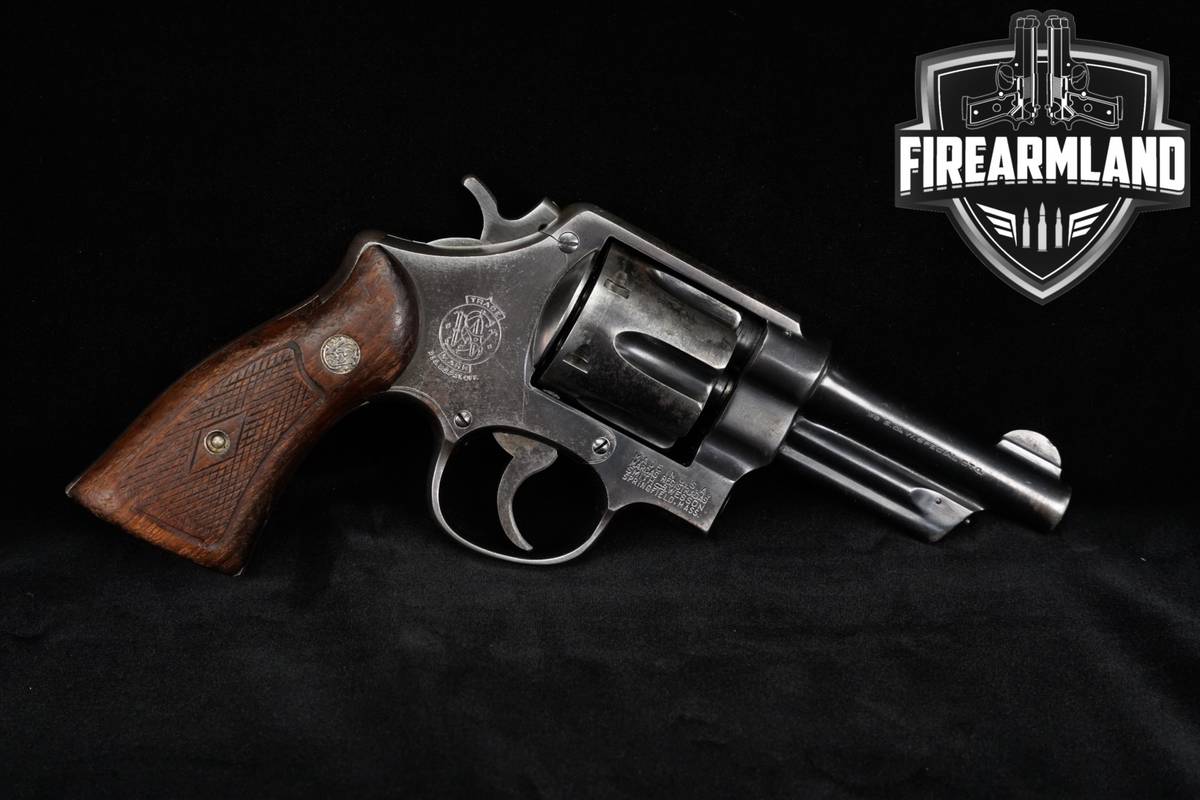
Smith & Wesson .38/44 Heavy Duty Pre-Model 20 4" Blued Revolver, 1953-54 Production
This post-war, five-screw N-frame .38/44 Heavy Duty represents the transitional high-pressure .38 Special platform that paved the way for the .357 Magnum. Produced circa 1953-1954, this pre-Model 20 revolver features matching serial numbers on the frame, yoke, and cylinder, a tapered 4-inch barrel with partial ejector-rod shroud, and original checkered walnut Magna stocks. Collectors value these revolvers for their robust build, limited production window, and direct link to Smith & Wesson’s evolution into magnum-caliber handguns.
Condition
Overall Condition: Fair – Extensive signs of prior use and handling.
Bore Condition: Fair – Generally clean with minor residue and slight corrosion.
Rifling Condition: Fair – Worn rifling with some loss of definition.
The revolver is mechanically sound. Lockup is tight, the double- and single-action trigger pull is smooth, and the bore remains bright despite exterior finish wear that includes widespread blemishes and scratches.
What’s Included
- Smith & Wesson .38/44 Heavy Duty pre-Model 20 revolver
Introduced in 1930 to harness high-velocity .38 Special loads, the .38/44 Heavy Duty was built on the same large N-frame used for the .44 Special. This 1950s example retains the classic five-screw frame, a feature phased out in later production, making it especially desirable to collectors tracking design changes.
The 4-inch carbon-steel barrel wears a half-moon forged front blade and service-notch rear sight milled into the top strap, providing a rugged, snag-free sight picture familiar to law-enforcement users of the era.
Original checkered walnut Magna stocks with factory silver S&W medallions remain on the gun, fitting the square-butt frame securely and showcasing period-correct styling.
The hammer-block safety, smooth combat-width trigger, and matching-numbered cylinder highlight Smith & Wesson’s attention to detail during this transitional period between wartime production and the modernization that followed.