
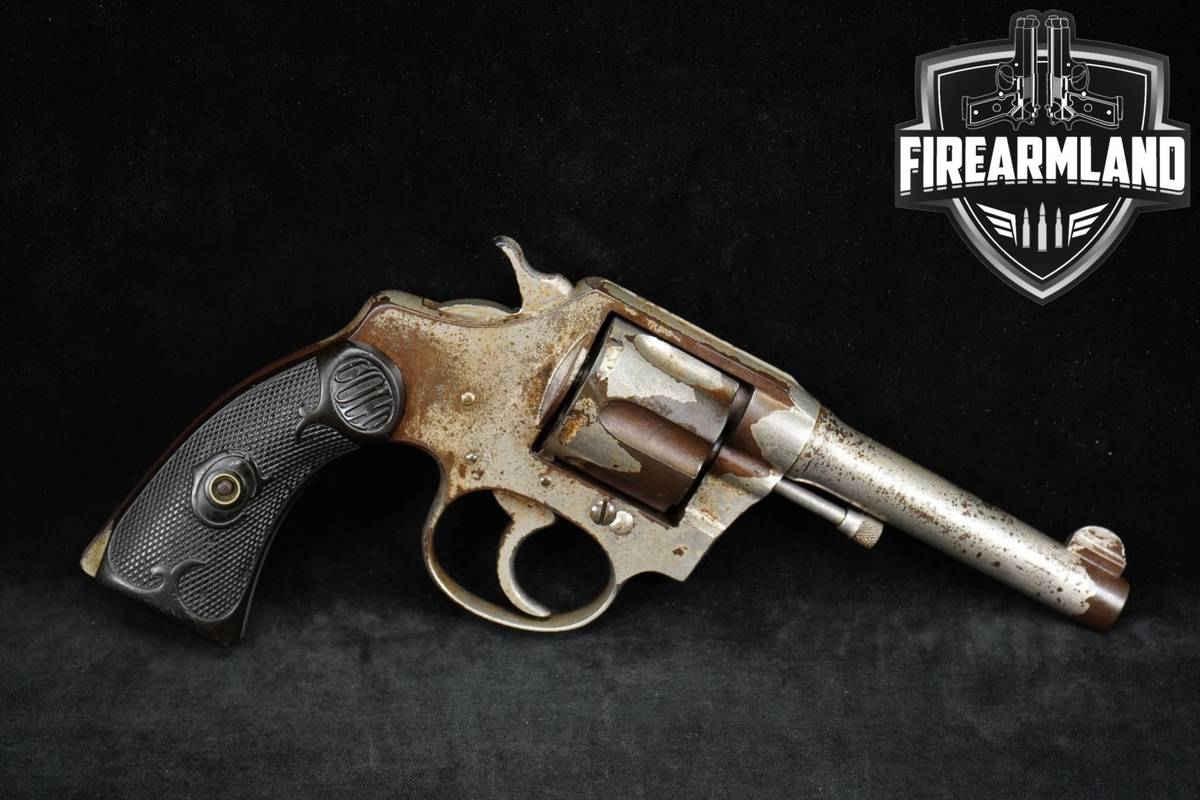
Colt Police Positive First Issue .38 S&W 4 inch Nickel DA/SA Revolver (6-Shot)
This 1910s-era Colt Police Positive First Issue is a nickel-finished, 4-inch, double-action/single-action revolver chambered in .38 S&W (Colt New Police). It carries the hallmark First Issue features, including a smooth topstrap, fluted swing-out cylinder, and black checkered hard-rubber grips with large oval "COLT" medallions. Clear barrel rollmarks and an inspector stamp add to its period-correct details.
Condition
Overall Condition: Fair condition, showing extensive signs of prior use and handling.
Bore Overall Condition: Fair - Generally clean, some residue or smudges, slight corrosion.
Bore Rifling: Fair Rifling - Worn rifling, slight loss of definition.
Specific Condition Notes: There is heavy rust and widespread finish loss throughout. The action cycles and functions. The revolver would benefit from thorough cleaning and restoration.
What's Included
- Colt Police Positive First Issue .38 S&W revolver
The Police Positive First Issue configuration is evident in its smooth (unserrated) topstrap and black checkered hard-rubber grips with large oval "COLT" medallions. The revolver uses a 6-shot, swing-out fluted cylinder and an unshrouded ejector rod with a knurled tip, true to early production features.
Chambered for .38 Colt New Police (.38 S&W), the barrel rollmarks clearly indicate the correct caliber for this model. The marking denotes .38 S&W rather than .38 Special, aligning with period factory offerings and helping ensure the correct ammunition choice.
Sights are fixed, with a half-moon front and an integral square-notch rear, providing a clean, duty-style sight picture. The trigger is smooth, and the revolver operates in double-action/single-action with Colt's Positive Lock hammer-block safety system.
The nickel-plated finish was a cataloged option on the Police Positive, and this example presents in nickel over carbon steel frame and barrel. Additional period details include the inspector stamp "O" below the serial on the frame cut and patent-date rollmarks on the barrel top from Aug. 5, 1884; June 5, 1900; and July 4, 1905.