
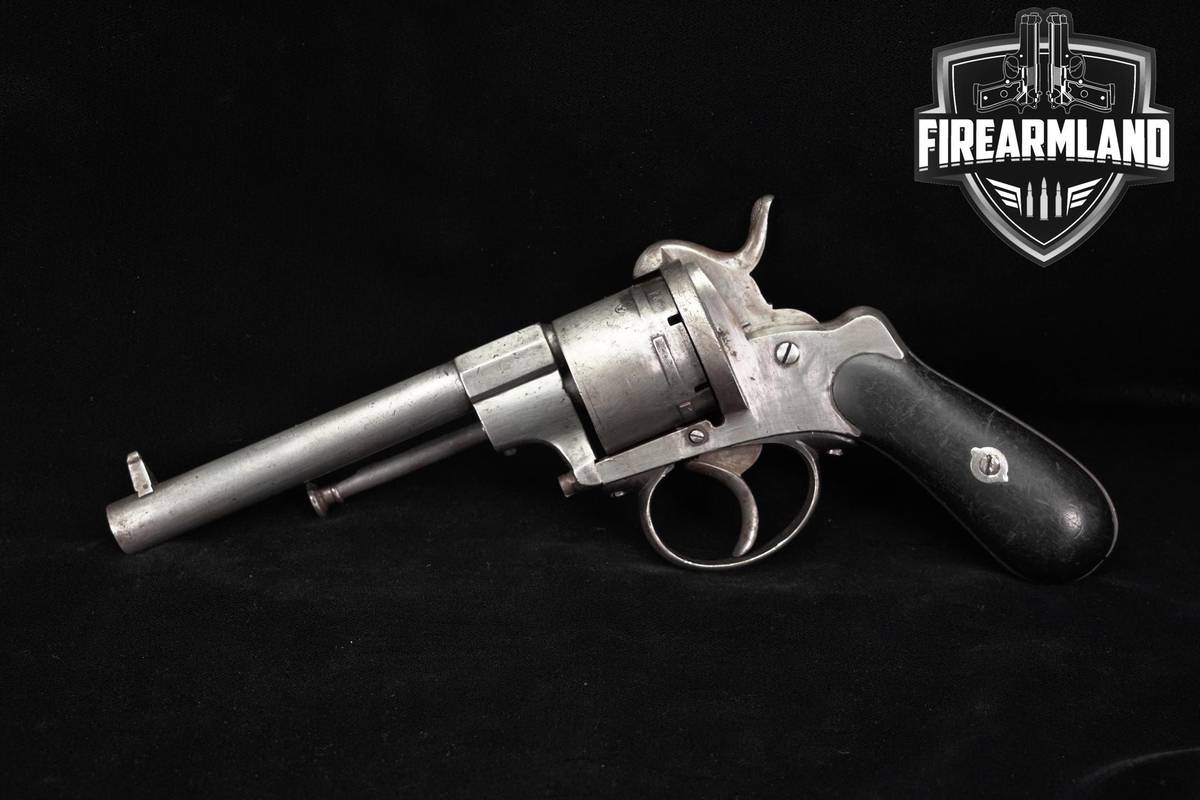
Liege Lefaucheux-Type 7mm Pinfire Open-Top Pocket Revolver, 6-Shot, 4.75 in Barrel
This is an antique, unmarked Liège (Belgium) Lefaucheux-type open-top pinfire pocket revolver chambered in 7mm pinfire. It has the typical 6-shot cylinder with elongated rectangular clearance cuts at the rear for the pinfire cartridge pins, along with a long round barrel and an underbarrel rod with a mushroom-style knob. The frame shows small proof-style marks, including an oval cartouche-type stamp near the cylinder/frame area, though the markings are not legible in the provided images.
Condition
Overall Condition: Good condition, showing some signs of prior use and handling.
Bore Condition: Good - Clean, well-maintained, minor wear marks.
Bore Rifling: Good Rifling - Intact, well-defined lands and grooves.
Finish Condition: Good condition, showing some signs of prior use and handling.
Mechanics: Good condition, showing some signs of prior use and handling.
Specific Condition Notes: The revolver shows signs of wear from handling, and there is visible surface rust.
What's Included
- Liege pinfire revolver
This revolver fits the profile of the widely encountered Belgian (Liège-made) 7mm pinfire pocket revolver pattern that was produced in large numbers for export. These were commonly made without a clearly marked maker name or model marking, and this example does not show a legible maker name, model name, or serial number in the provided images.
It is built on the classic Lefaucheux-type layout with an open-top frame and an exposed hammer, using a DA/SA action. The 6-shot cylinder is cut to clear the protruding pins of pinfire cartridges, a key visual identifier of the system.
Configuration details include fixed sights with a fixed front blade (a rear sight is not clearly visible), black grip panels secured with a single screw, and a bright-finish metal surface. The butt has a lanyard-ring style through-hole, though no ring is present or visible.
Proof-style marks are present on the cylinder/frame area, including a small oval cartouche-style stamp and additional small stamps, but they are illegible. These marks are consistent with the general Liège workshop production style seen on many unmarked pinfire revolvers of this type.