
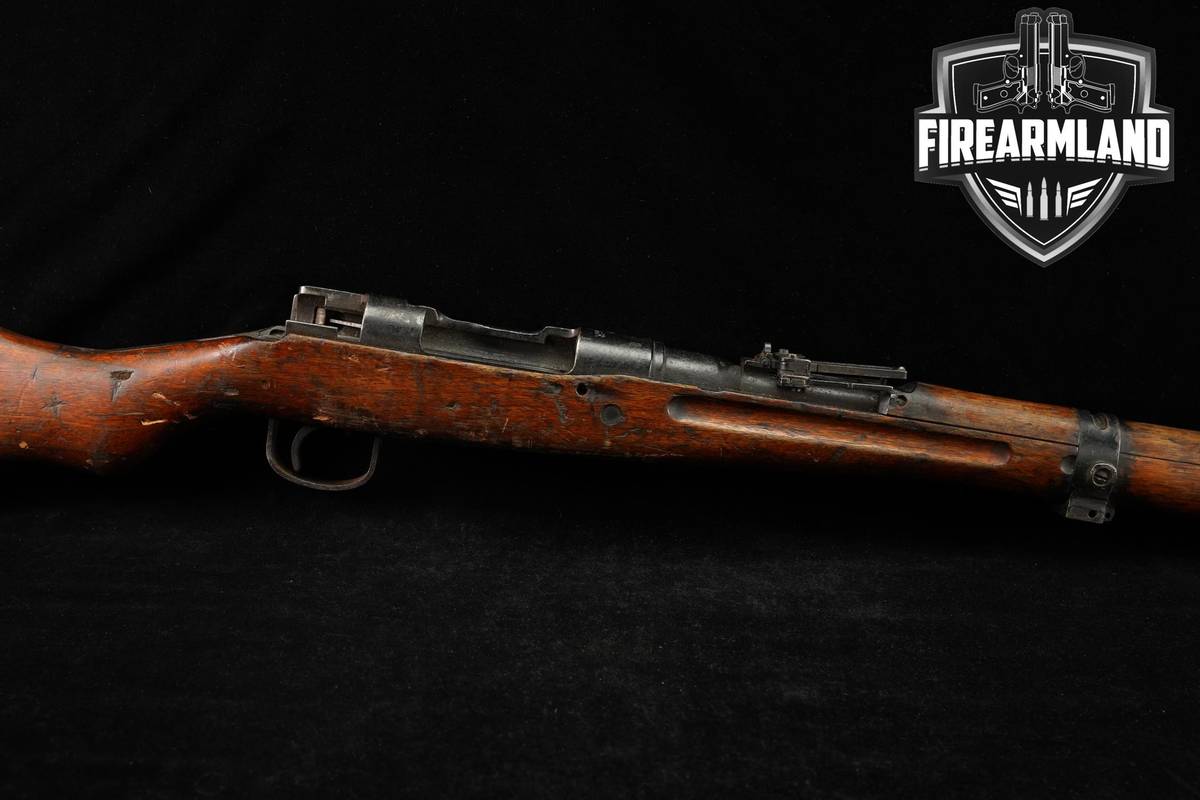
WWII Japanese Type 99 Short Rifle, 7.7 Japanese, 25.9 in Barrel, Early/Mid-War Aircraft Rear Sight
This WWII-era Japanese Type 99 Short Rifle is a collectible military bolt-action chambered in 7.7 Japanese, made in Japan most likely during 1941–1945. It features the short-rifle configuration with a 25.9 inch barrel and an early/mid-war rear sight complete with fold-out aircraft lead arms. The receiver ring bears the Japanese '九九式' model mark, with a kana prefix and circular arsenal/series symbol present. The imperial chrysanthemum crest is not visible on the receiver ring.
Condition
Overall Condition: Poor condition.
Bore Condition: Fair - Generally clean, some residue or smudges, slight corrosion.
Bore Rifling: Fair Rifling - Worn rifling, slight loss of definition.
Specific Condition Notes: The bolt is missing. The hardwood stock exhibits heavy scratching.
What’s Included
- Type 99 Short Rifle in 7.7 Japanese (bolt not included)
- Internal 5-round magazine with hinged floorplate
- Early/mid-war rear sight with fold-out aircraft lead arms
- Full-length hardwood stock with separate upper handguard and left-side finger groove
- Two barrel bands and metal buttplate
- Bayonet lug integral to the nose cap
- Sling swivels
This Type 99 is the short-rifle configuration with a 25.9 inch barrel and a fixed internal 5-round magazine fed by a hinged floorplate. It is chambered in 7.7 Japanese and uses a rear safety knob typical of the pattern. The action is bolt-operated by design.
The iron sight setup includes a front blade protected by ears and a tangent/ladder rear sight with a sliding elevation scale. The fold-out aircraft lead arms are present, a notable early/mid-war feature that adds historical interest.
The rifle wears a full-length hardwood stock with a separate upper handguard and a left-side finger groove, secured by two barrel bands. Hardware includes a metal buttplate, a bayonet lug integral to the nose cap, and sling swivels at the left butt and bottom middle band.
Receiver markings include the Japanese '九九式' model mark on the ring, a kana prefix ahead of the serial number, and a circular arsenal/series symbol. The imperial chrysanthemum crest is not visible on the receiver ring.
As configured, this example reflects wartime production from Japan, most likely during 1941–1945. The cleaning rod, dust cover, and monopod are not present.