
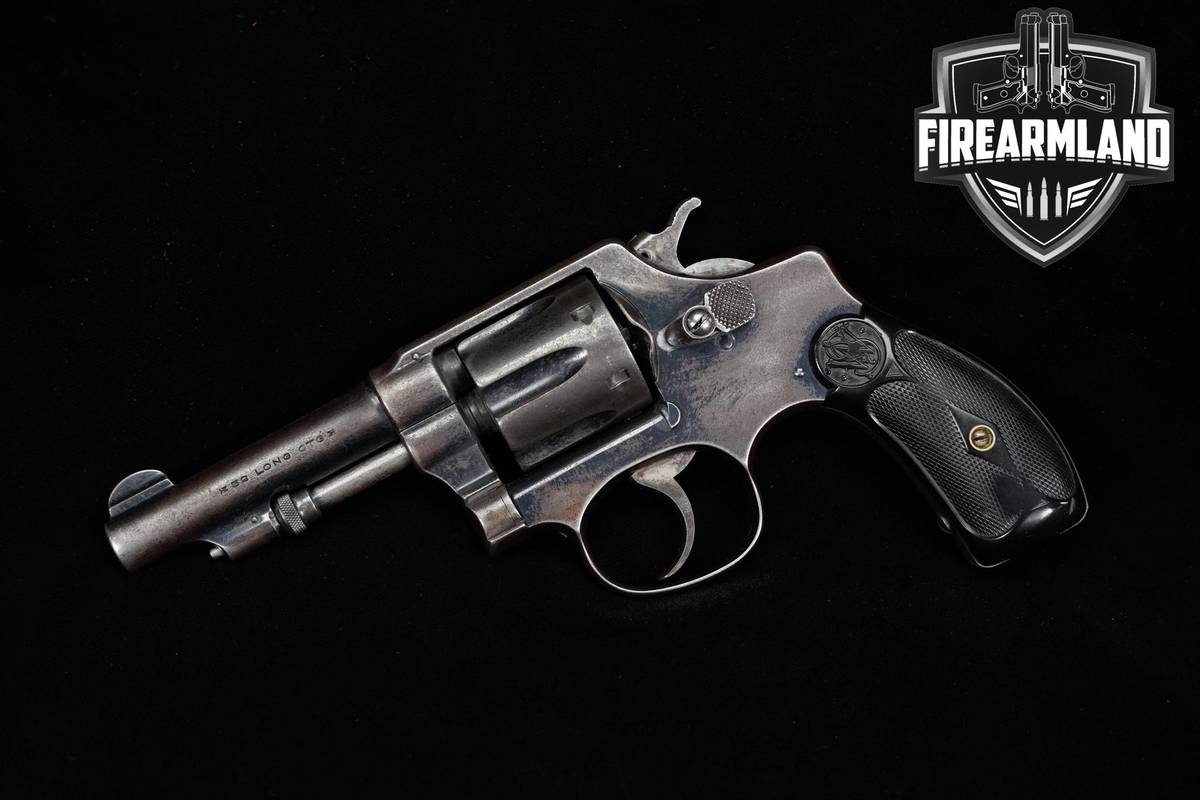
Smith & Wesson .32 Hand Ejector Model of 1903, 5th Change, .32 S&W Long, 3.25 in Barrel, I-Frame Revolver
This Smith & Wesson .32 Hand Ejector Model of 1903, 5th Change, is a United States-made I-frame revolver chambered in .32 S&W Long with a 3.25 inch barrel and a six-shot fluted cylinder. It falls within the circa 1910–1917 production window and features matching serial numbers on the butt and barrel flat with a prefix letter. Period-correct rollmarks list the 1901, 1906, and 1909 patent dates, and the right sideplate carries the S&W circular TRADE MARK logo.
Condition
Overall Condition: Fair condition, showing extensive signs of prior use and handling.
Bore Overall Condition: Good - Clean, well-maintained, minor wear marks.
Bore Rifling: Good Rifling - Intact, well-defined lands and grooves.
Specific Condition Notes: Much of the original high-polish bluing has thinned or turned to a mottled grey/brown patina, with light surface peppering and handling marks on the frame and cylinder. The bore is bright with distinct rifling, and the cylinder chambers show no major pitting. Single- and double-action timing is functional with some play in the lock-up.
What’s Included
- Moose Brand (Bauer Bros. Mfg. Co., St. Louis, MO) soft pistol rug
The 5th Change variant of the Model of 1903 reflects Smith & Wesson’s early I-frame development in .32 S&W Long. This double-action/single-action revolver retains its classic round-butt configuration, 3.25 inch barrel, and six-shot fluted cylinder, delivering the compact proportions associated with the series.
It wears a blued finish over carbon steel construction for the frame, cylinder, and barrel. Fixed sights consist of a half-moon front blade and a topstrap groove rear, providing a period-correct sighting arrangement suited to the revolver’s size and role.
Controls and features include the large knurled mushroom-style ejector-rod head with a front locking lug, a hallmark of early S&W design. The right sideplate bears the S&W circular TRADE MARK logo, and the top of the barrel shows rollmarks with 1901, 1906, and 1909 patent dates.
Markings and numbers align with factory practice of the era: the butt and barrel flat show matching serial numbers with a prefix letter, and a separate assembly number appears in the yoke cut. These details support its placement within the circa 1910–1917 timeframe for the Model of 1903, 5th Change.