
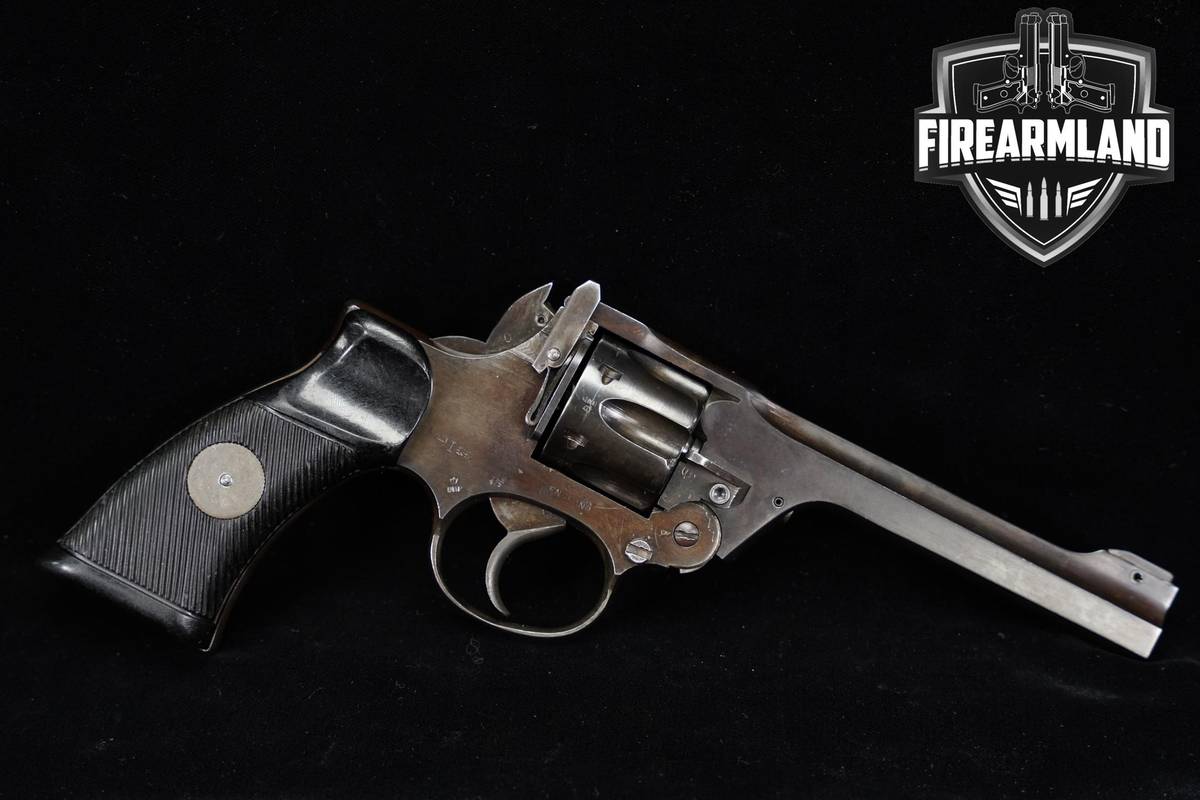
Enfield No. 2 Mk I .38 S&W Top-Break Revolver, 5 in Barrel, 1944, Crown/BNP Proofs, ENGLAND Export Mark
This 1944 Enfield No. 2 Mk I is a WWII-era British top-break revolver chambered in .38 S&W with a 5 inch ribbed barrel. It features the Mk I double-action/single-action configuration with a spurred, checkered hammer, commercial Crown over BNP proofs, and the ENGLAND export mark. Caliber markings include ".38 767" and "CAL:38," and a ZC serial prefix is observed on multiple components.
Condition
Overall Condition: Fair condition, showing extensive signs of prior use and handling.
Bore Overall Condition: Good - Clean, well-maintained, minor wear marks.
Bore Rifling: Good Rifling - Intact, well-defined lands and grooves.
Specific Condition Notes: The bluing has largely faded to a mottled grey/brown patina, with scattered surface peppering and handling marks across the frame and barrel. Mechanically, the action gums up at times and does not cycle properly, requiring a gunsmith's attention. Potential causes include timing issues, buildup in the crane mechanism, or wear on the sear.
What’s Included
- Enfield No. 2 Mk I .38 S&W revolver
The No. 2 Mk I configuration is identified by its spurred, checkered hammer and double-action/single-action operation. This example uses the Enfield top-break stirrup-latch system with an automatic star extractor and a six-shot fluted cylinder, combining fast ejection with straightforward handling.
Sights are fixed, with a square-notch rear integral to the top latch and a fixed front blade set on the ribbed barrel. The 5 inch steel barrel and all-steel construction reflect the robust wartime build typical of British service revolvers.
Markings include Crown over BNP commercial proofs, BNP 3 1/2 TONS, ".38 767," and "CAL:38," all consistent with .38 S&W (.380 Revolver/.38-200). The ENGLAND export mark is present, indicating commercial export after its British service use.
Black checkered synthetic (Bakelite-type) grip panels are fitted, and the revolver shows a ZC serial prefix on multiple components. Manufactured in 1944 in the United Kingdom, it represents a WWII-era Enfield with commercially applied proof and export markings.