
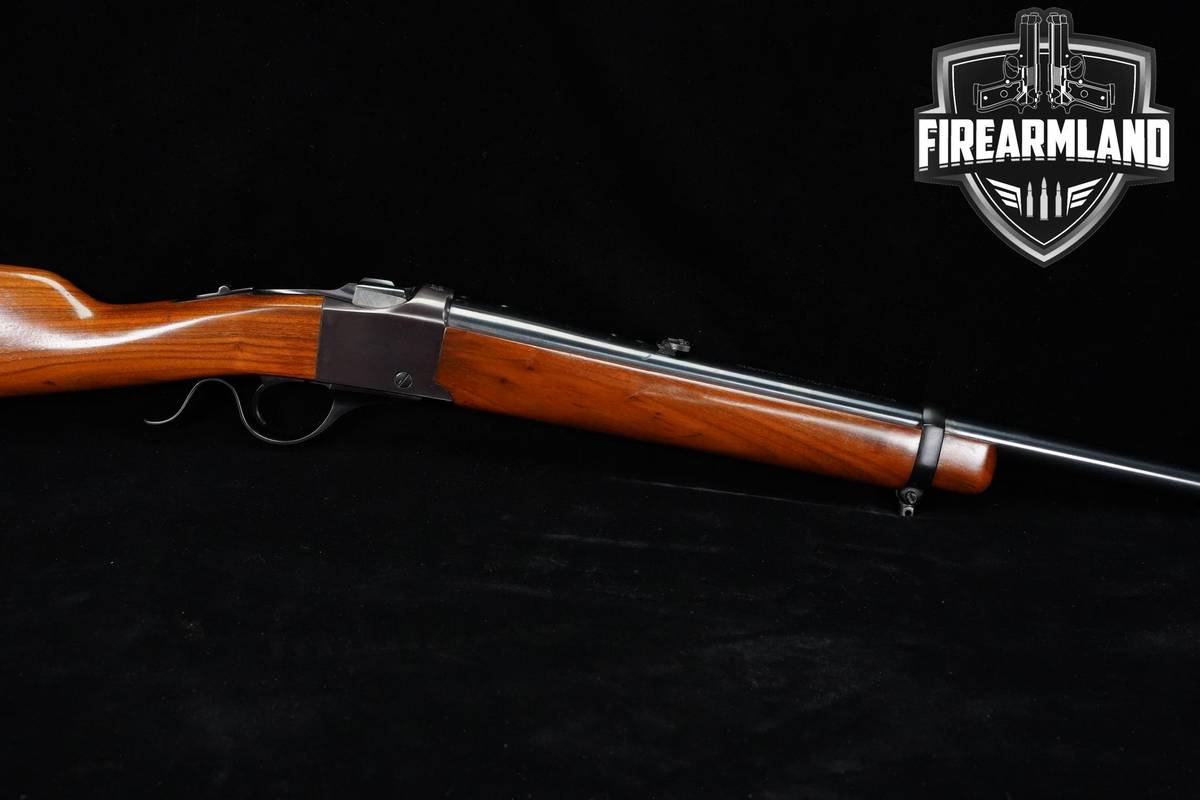
Ruger No. 3 .45-70 Gov't Single-Shot Carbine, 22-inch Blued Barrel, Falling-Block Action, Open Sights (1979–1980)
This Ruger No. 3 is a .45-70 Gov't single-shot carbine with a 22-inch round blued barrel, a Farquharson-style hammerless under-lever falling-block action, and classic open sights. It dates to the 1979–1980 manufacturing period, with a barrel address marked Southport, Conn., U.S.A., and bears the Ruger circled 'R' proof. Its lightweight configuration, straight-grip hardwood stock, and carbine forend with barrel band deliver a traditional, handy big-bore single-shot package.
Condition
Overall Condition: Good condition, showing some signs of prior use and handling.
Bore Overall Condition: Excellent - Clean, mirror finish, no signs of wear.
Bore Rifling: Excellent Rifling - Sharp lands and grooves.
Specific Condition Notes: There is a large scratch on the stock. A spot on the barrel is missing finish. A few scratches and abrasions appear on the barrel. These marks are typical from normal handling and use.
What’s Included
- Ruger No. 3 Single-Shot Carbine instruction manual
The No. 3 uses a Farquharson-style hammerless under-lever falling-block action, chambered here in .45-70 Gov't, and feeds a single round. This simple, robust mechanism is paired with a blued carbon steel receiver and a 22-inch round blued carbon steel barrel.
Sighting equipment is traditional and field-ready: a ramped front post with protective ears and a folding rear leaf with elevator. The configuration supports quick, repeatable sight pictures without added complexity.
The hardwood stock set features a straight grip and uncheckered surfaces, complemented by a carbine forend with a barrel band. Sling swivel studs are installed. The length of pull measures 13.0 inches, contributing to a compact, easy-handling profile at approximately 6 lb.
Production details include U.S. manufacture, a barrel address marked Southport, Conn., U.S.A., and the Ruger circled 'R' proof. The serial range aligns with a late-1979 shipping block, placing this example squarely in the 1979–1980 period.