
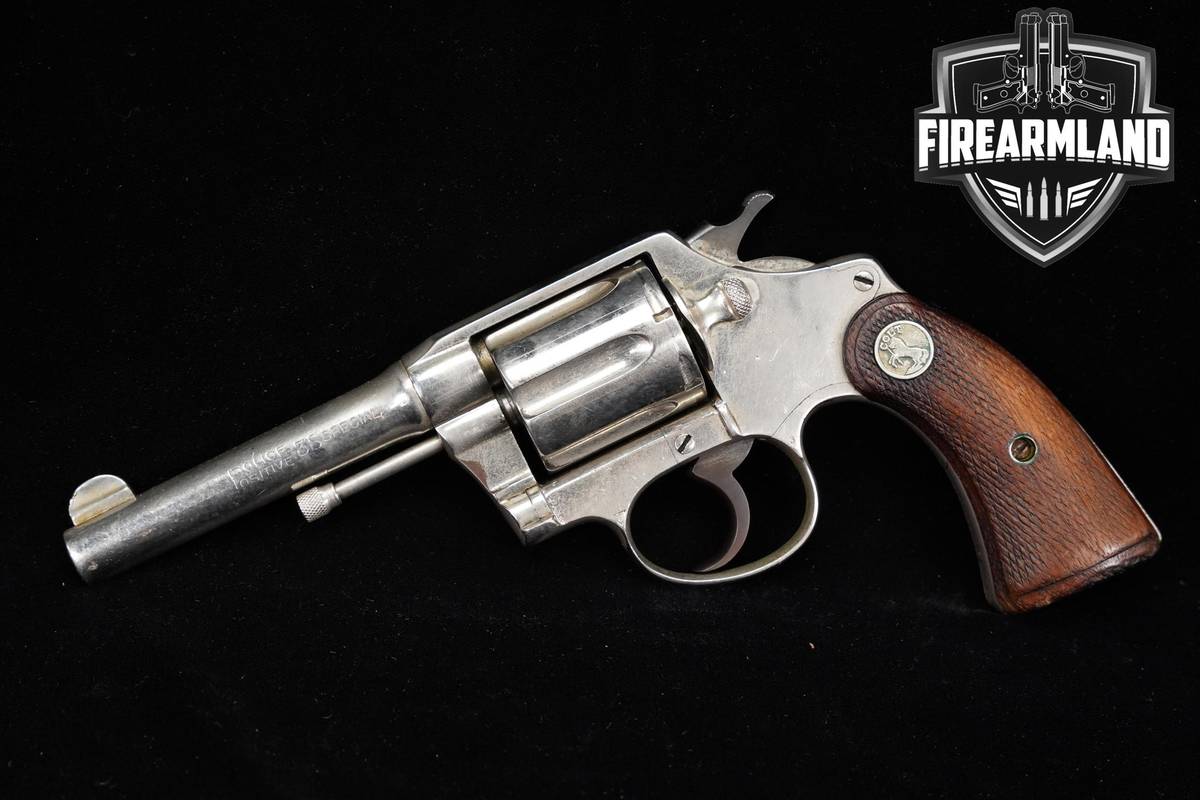
Colt Police Positive Special First Issue .38 Special, Nickel-Plated, Madison County Idaho Property-Marked (1911)
This 1911 Colt Police Positive Special stands out as an early First Issue D-frame revolver with a factory nickel-plated finish and a documented "Madison County Idaho" property inscription on the left side of the frame. Chambered in .38 Special with a six-shot cylinder, it shows hallmark early-production features that define this variant.
Condition
Overall Condition: Good condition, showing some signs of prior use and handling.
Bore Condition: Good - Clean, well-maintained, minor wear marks.
Bore Rifling: Good Rifling - Intact, well-defined lands and grooves.
Specific Condition Notes: This firearm has visible signs of wear and handling. Scratches and blemishes appear across the surfaces. It carries the look of normal use.
What's Included
- Colt Police Positive Special First Issue revolver
As a First Issue configuration, this Police Positive Special features the unshrouded ejector rod and a half-moon front blade paired with a top-strap groove rear sight. The rearward-pull cylinder latch is consistent with Colt service revolvers of the era. The barrel carries the two-line Colt address/patent text on top, with the left-side rollmark reading "POLICE POSITIVE .38 SPECIAL."
The revolver is built on Colt's D-frame and operates in double-action/single-action. It is chambered in .38 Special with a six-round cylinder. Colt's Positive Lock hammer-block safety is present, providing the model's namesake internal safety feature.
Materials and finish are period-correct: carbon steel construction with nickel plating on the frame, cylinder, and receiver, and a carbon steel barrel. The stocks are checkered walnut with silver Colt medallions, adding a classic Colt touch to the early-production aesthetic.
Provenance and markings add clarity to its history. The left side of the frame is engraved "Madison County Idaho," indicating county property usage. This example was manufactured in 1911 in the United States, aligning with its First Issue features and early rollmarks.