
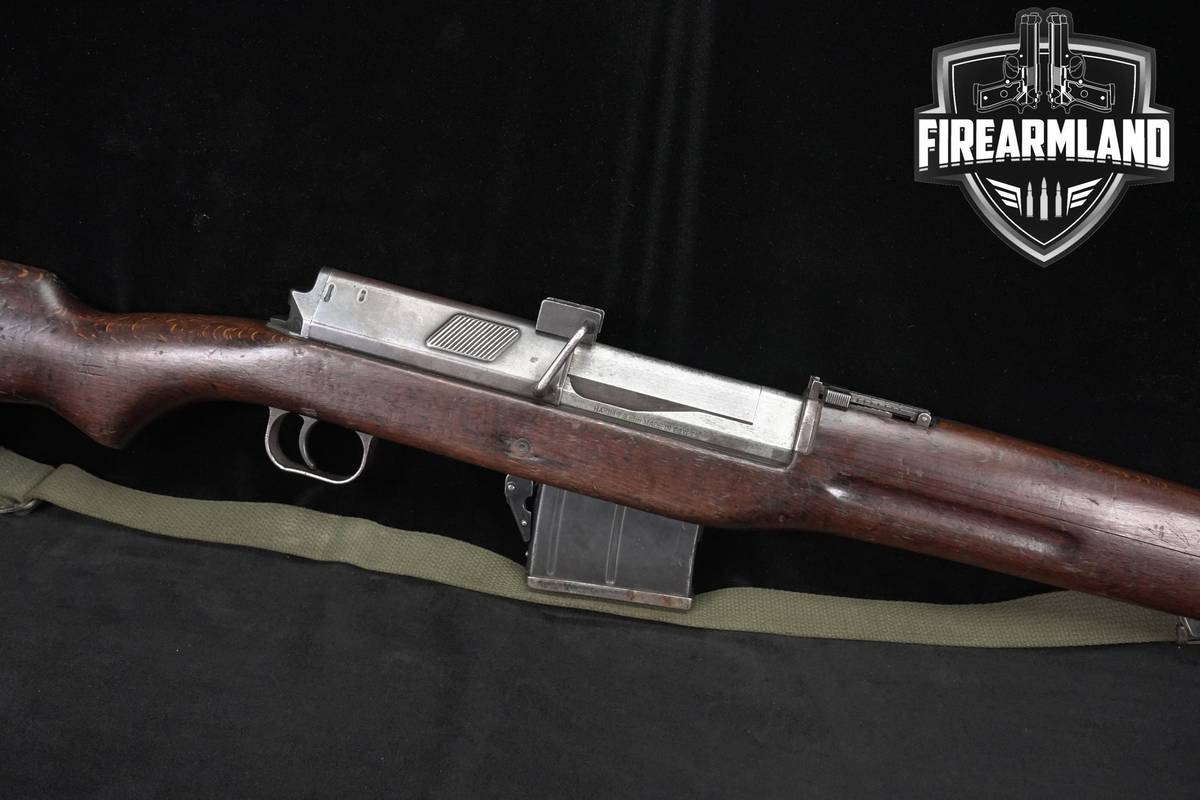
Maadi Hakim 7.92x57mm Semi-Auto Rifle, 23.5 in Barrel, Ljungman-Pattern, Egyptian 1950s–1960s
This Maadi Hakim is an Egyptian semi-automatic rifle chambered in 7.92x57mm Mauser from the 1950s–1960s. It uses a Ljungman-pattern direct impingement system with an open-top receiver and charger-clip loading through the top cover guide. Notable features include Arabic-marked tangent ladder sights, a 23.5-inch barrel, a steel receiver, and a full-length hardwood stock. Capacity is 10+1 with the included 10-round detachable magazine.
Condition
Overall Condition: Good condition, showing some signs of prior use and handling.
Bore Overall Condition: Good - Clean, well-maintained, minor wear marks.
Bore Fouling: Mild Fouling - Light buildup of fouling or dirt.
Bore Rifling: Good Rifling - Intact, well-defined lands and grooves.
Specific Condition Notes: There is wear and scuffing throughout consistent with a service rifle. The stock has a crack just ahead of the buttplate. The front section of the handguard is not present. The muzzle device has been modified. The bore shows blemishes, while the rifling remains well defined.
What’s Included
- 1x 10-round steel detachable box magazine
- Green web sling (installed)
The Hakim’s Ljungman-pattern operating system delivers semi-automatic function via direct impingement, paired with an open-top receiver that facilitates charger-clip loading through the guided top cover. The charging piece features ribbed grasping panels for a secure handhold.
Sighting is handled by a tangent rear ladder graduated with Arabic numerals from 1 to 10, matched to a hooded front post. This rifle has a 23.5-inch barrel and a stated capacity of 10+1 using its detachable 10-round magazine.
The hardwood stock is a full-length, one-piece pattern with a finger-groove fore-end and fixed sling swivels. Length of pull measures 13.25 inches, offering a traditional service-rifle fit.
Receiver markings include "HAKIM 7.9 mm MADE IN EGYPT" alongside Arabic-script legends, aligning with its Egyptian Maadi manufacture in the 1950s–1960s. The receiver is steel, with configuration for charger-clip loading via the top cover/guide.