
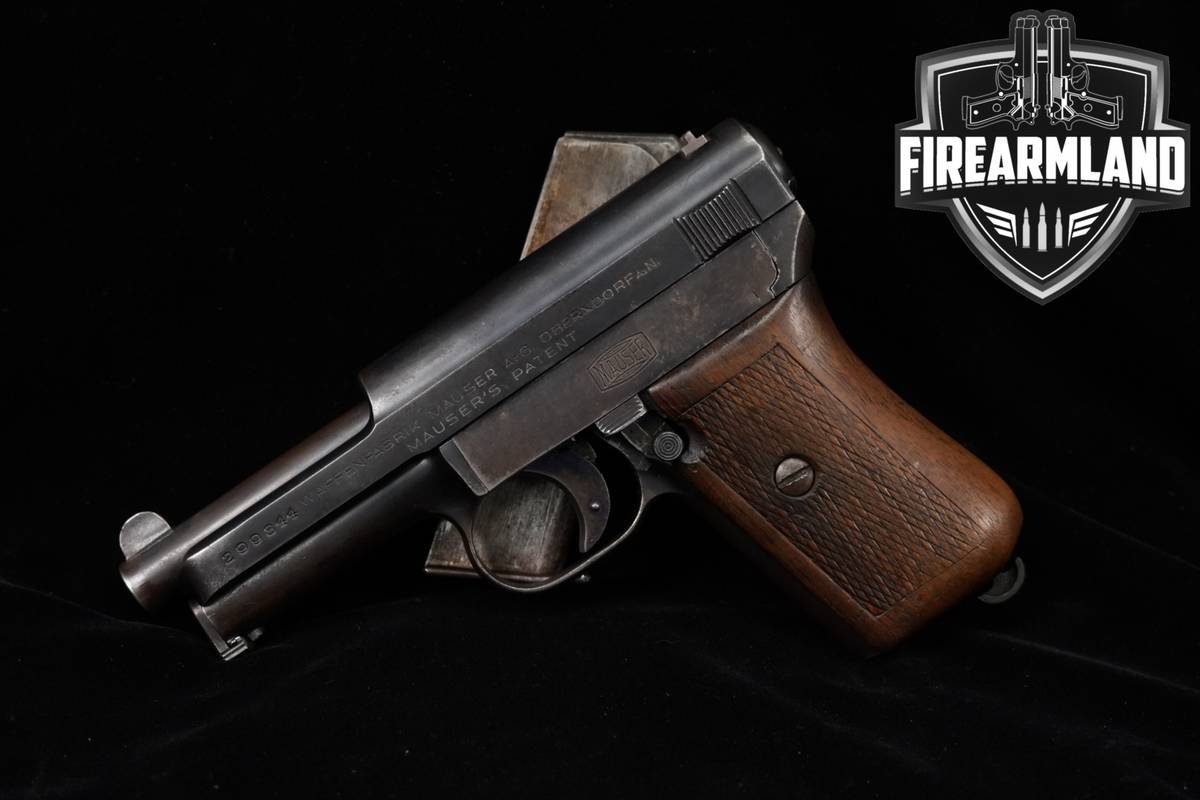
Mauser Model 1914 New Model Weimar-Era .32 ACP, 3.4 in Barrel, Blued Finish, Checkered Walnut Grips, 8+1
This Weimar-era Mauser Model 1914 New Model is a commercial-pattern .32 ACP pistol made circa 1923–1924. It features correct pre-1934 commercial markings, the Mauser banner on the left sideplate, and matching serial numbers on the slide and on the rear of the frame just below the striker cap. Compact and well-appointed, it retains hallmark details such as the fixed barrel, heel-type magazine release, and a lanyard ring at the butt.
Condition
Overall Condition: Good condition, showing some signs of prior use and handling.
Bore Overall Condition: Good - Clean, well-maintained, minor wear marks.
Bore Rifling: Good Rifling - Intact, well-defined lands and grooves.
Specific Condition Notes: There is notable finish loss with areas of pitting and rust present. The chamber is clean.
What's Included
- 1x 8-round steel magazine with three elongated witness slots and a flat floorplate
Built on Mauser’s simple blowback, striker-fired system, this New Model retains the fixed barrel and compact profile favored in the period. Chambered in .32 ACP with an 8+1 capacity and a 3.4 in barrel, it balances concealability with period-correct functionality. The heel-type magazine release and manual safety reflect the design language of early 20th-century European pocket pistols.
Markings are consistent with a Weimar-era commercial pistol. The right slide is marked "MAUSER–7,65" and the left slide carries the two-line legend "WAFFENFABRIK MAUSER A.-G. OBERNDORF a.N." over "MAUSER'S PATENT." The left sideplate shows the Mauser banner logo. It bears pre-1934 commercial markings with the absence of Third Reich-era Eagle/N proofs.
Controls and features include rear slide serrations, an open-top ejection port, a round rear striker cap, and a lanyard ring at the butt. The sights are fixed, with a front blade on an integral pedestal and an integral rear notch in the striker housing. Checkered walnut grips and a blued finish complete the classic appearance.
This example aligns with the Weimar-era commercial configuration known as the New Model. The matching serial numbers on the slide and the rear of the frame just below the striker cap, along with the correct legends and features, make it a well-documented variant from 1923–1924 production.