
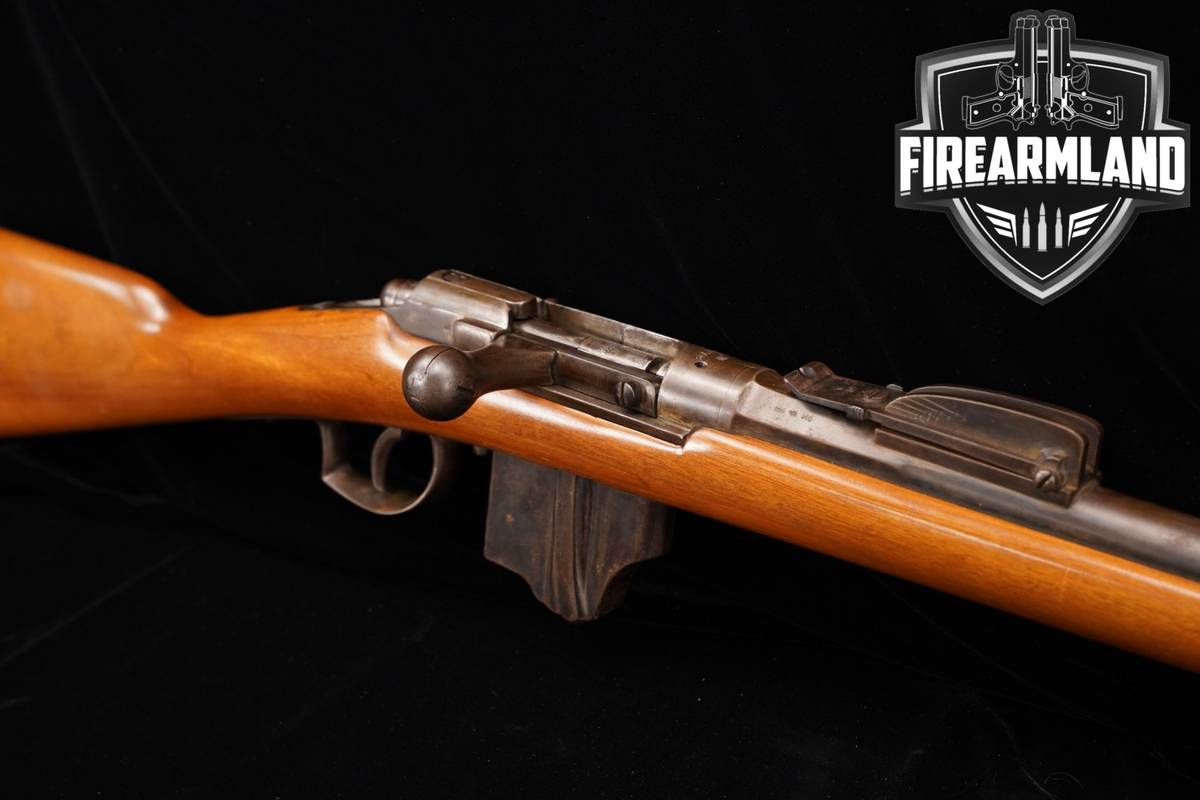
Émile & Léon Nagant Beaumont-Vitali M1871/88 11.3x50R Dutch Infantry Rifle, 32.75 in Barrel, 4-Round Vitali Magazine
Belgian-made by Émile & Léon Nagant in Liège, this Dutch Beaumont-Vitali M1871/88 is an antique infantry rifle chambered in 11.3x50R Beaumont. It features the Vitali 4-round box magazine conversion, a 32.75 in barrel, and matching serial markings on the receiver and bolt. Distinctive period markings include "1877" on the barrel top flat and "1891" on the buttplate tang, with a roundel cartouche on the right butt and inspector-style monograms near the barrel marking.
Condition
Overall Condition: Poor condition.
Bore Overall Condition: Fair - Generally clean, some residue or smudges, slight corrosion.
Bore Rifling: Fair Rifling - Worn rifling, slight loss of definition.
Specific Condition Notes: The trigger is sticky, and the sear does not fully engage on every reset. Do not fire this rifle until it has been inspected by a qualified gunsmith.
What’s Included
- Émile & Léon Nagant Beaumont-Vitali M1871/88 rifle (11.3x50R)
Manufactured in Liège for Dutch service, this M1871/88 reflects the Vitali magazine upgrade applied to earlier Beaumont rifles. The 4-round box magazine is integral to the conversion, offering period-correct capacity in the original 11.3x50R Beaumont chambering.
The rifle uses a 32.75 in barrel and a full-length hardwood stock with a straight wrist and steel buttplate. It is full-size with a 14 in length of pull. Two gas-vent holes are positioned on the right side of the receiver ring. Sling swivels are fitted at the toe and on the single barrel band.
Sighting equipment is classic for the pattern: a blade front sight paired with a fan-shaped quadrant/leaf rear sight bearing radial graduations. There is no handguard, consistent with the configuration.
Markings and numbers include matching serial markings observed on the receiver and bolt, with additional assembly numbers on other components. The barrel top flat is stamped 1877, and the buttplate tang is stamped 1891. Inspector-style monograms appear near the barrel marking, and the stock shows a circular roundel cartouche on the right butt.
The nose cap/front band provides a bayonet mounting interface. A cleaning-rod channel is present in the stock, though no rod is installed. The receiver is steel, and overall construction aligns with late-19th-century Belgian manufacture by Émile & Léon Nagant.