
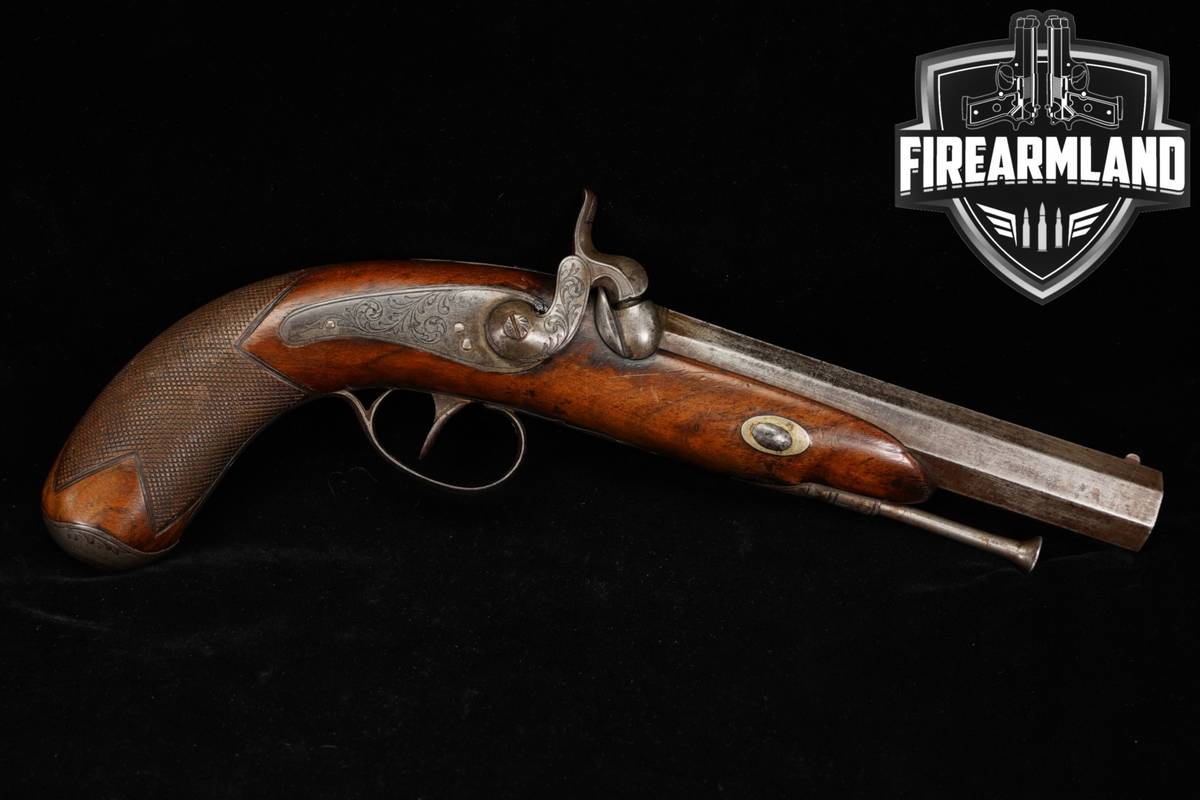
Belgian Liège .69 Cal Single-Shot Percussion Traveling/Holster Pistol, 6.5 in Octagonal Barrel, c. 1858–1865
This Liège-made, guild-produced single-shot percussion pistol is a large-bore .69 caliber example dated to roughly 1858–1865 by its Belgian proofmarks. It features a 6.5 inch octagonal barrel secured by a single transverse wedge, a captive ramrod with a flared trumpet head, and an integral snail-style bolster (patent breech) with a curved flash fence. Scroll engraving, fine checkering, and a pistol-grip compartment add period-correct detail and utility.
Condition
Overall Condition: Very good condition, showing only light, superficial signs of prior handling or use.
Bore Overall Condition: Good - Clean, well-maintained, minor wear marks.
Bore Fouling: Mild Fouling - Light buildup of fouling or dirt.
Bore Rifling: Good Rifling - Intact, well-defined lands and grooves.
Specific Condition Notes: Markings and finish loss are present from prior handling and use. The bore shows wear to the rifling with areas smoothed by age and only light surface fouling mid-bore. The lock functions at half cock and full cock, and the mainspring tension remains strong. Fitment is tight; the wedge/takedown pin and screws are secure.
What’s Included
- Belgian Liège single-shot .69 caliber percussion pistol
Built in Liège by guild craftsmen, this single-shot traveling/holster pistol combines a powerful .69 caliber bore with a compact 6.5 inch octagonal barrel. The barrel is secured by a single transverse wedge with oval escutcheons, and the pistol retains its original captive/swivel ramrod with a trumpet head for quick loading.
Belgian proofmarks authenticate its origin and era. The pistol bears the Banc d'Epreuves des Armes a Feu de Liège definitive proof (ELG over star in oval, uncrowned), identifying it as pre-1893, along with the Le Perron inspection mark and the Belgian provisional proof (post-1852). Together, these marks date the pistol to approximately 1858–1865.
Sighting is straightforward with a fixed front blade and no separate rear sight, consistent with the type. An integral snail-style bolster (patent breech) with a curved flash fence complements the percussion sidelock action, and the single-shot capacity reflects the pistol's intended defensive and traveling role of the period.
Fit and finish details include scroll engraving on the lockplate, hammer, and trigger-guard tang. The bag-shaped grip features fine checkering, a metal buttcap, and a functional pistol-grip compartment (trap); there is no wrist escutcheon. These period details, combined with tight mechanical fitment, give the pistol strong historical character.