
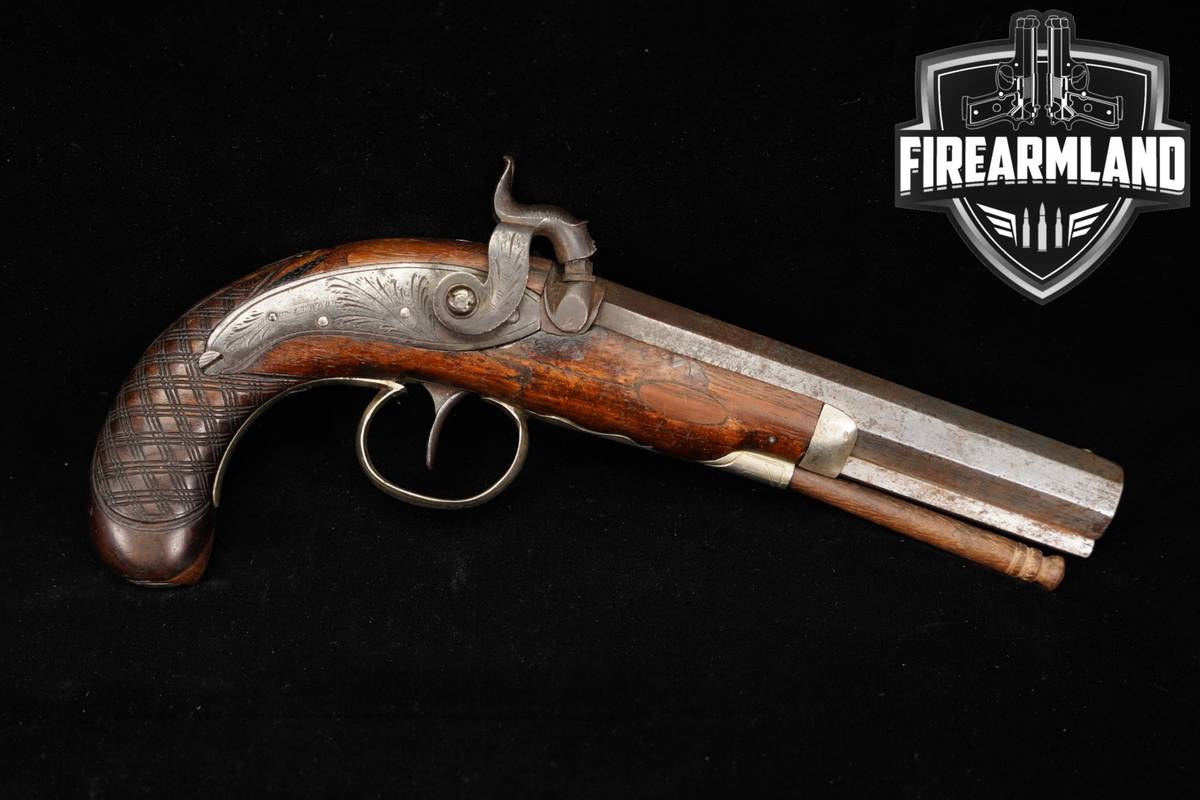
T. Atwood London Percussion Single-Shot Pistol, 6" Octagonal Barrel, Foliate Engraved, UK Antique (Percussion Era, c. 1820s–1850s)
This English percussion-era single-shot pistol is signed "T. ATWOOD" on the lockplate and features a 6" octagonal barrel with two decorative breech bands. It presents foliate engraving on the lockplate, hammer, top tang, and mounts, along with white-metal furniture and a full-length walnut stock with a finely checkered bag-shaped grip. Time-appropriate proof marks, period-correct assembly numbers, and a period-style workman’s mark add to its historical appeal. The bore diameter was measured at 0.48", while a prior owner stated .44 caliber; the caliber is not verified.
Condition
Overall Condition: Fair condition, showing extensive signs of prior use and handling.
Bore Condition: Fair - Generally clean, some residue or smudges, slight corrosion. No evident rifling is visible at the muzzle in the provided photos.
Specific Condition Notes: Surface pitting is present throughout the barrel. The walnut stock shows various handling marks, dings, and scratches. Proof marks and engravings remain legible. The caliber is not verified.
What’s Included
- T. Atwood London single-shot percussion pistol
The lockplate is signed "T. ATWOOD" and displays foliate engraving that continues onto the hammer, top tang, and mounts. The top-flat inscription is present but illegible. Time-appropriate proof marks and all lettering match the period, supporting its 19th-century English origin.
The 6" octagonal barrel carries two decorative breech bands; sight configuration is not confirmed in the photos. A drum-and-nipple bolster supports the external-hammer, single-shot, muzzle-loading percussion system.
The full-length walnut stock runs to the muzzle and features a bag-shaped grip with fine cross-hatched checkering and border lines. White-metal (German/nickel silver–appearing) furniture includes the trigger guard, nose/entry cap, ramrod pipes, a wrist inlay, and a circular, hinged butt cap box (cap trap), all consistent with period English craftsmanship.
A transverse wedge/key through a barrel lug secures the barrel to the stock; an oval escutcheon and keyway are present in the forend, and the wedge/key itself is not present.
The bore diameter was measured at 0.48". A previous owner stated it as .44 caliber; the caliber is not verified. Muzzle photos show no evident rifling. Overall markings and proofs remain legible and are consistent with the percussion era, circa 1820s–1850s.