
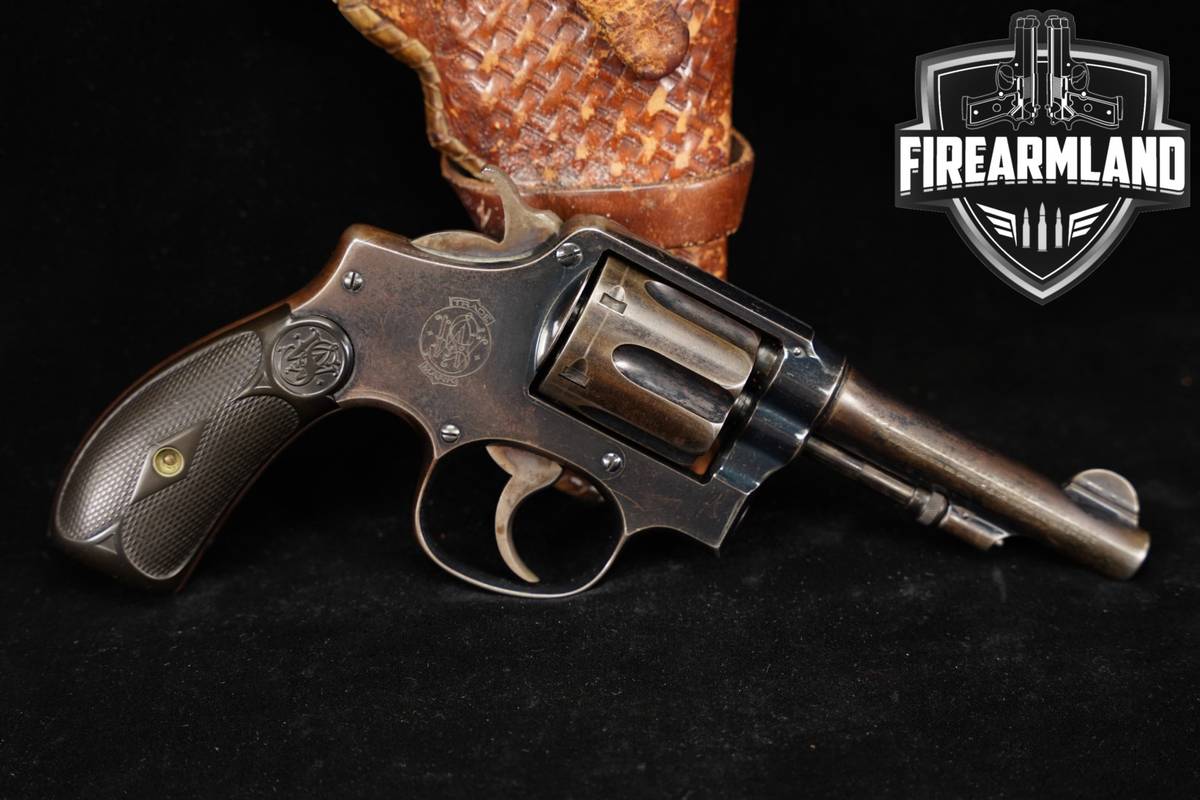
Smith & Wesson .32-20 Hand Ejector Model of 1902, 4 Inch, Pre-WWI Five-Screw K-Frame, Blued
This Smith & Wesson .32-20 Hand Ejector Model of 1902 is an early K-frame revolver made between 1902 and 1905, chambered in .32-20 Winchester and built with a 4-inch barrel. It features hallmark early-production details including a five-screw frame with trigger-guard screw, an under-barrel ejector-rod locking lug with a knurled mushroom head, and an early checkered cylinder release. The barrel is rollmarked ".32 WINCHESTER CTG." and the revolver retains matching serial numbers on the butt and cylinder.
Condition
Overall Condition: Fair condition, showing extensive signs of prior use and handling.
Bore Condition: Fair - Generally clean, some residue or smudges, slight corrosion.
Bore Rifling: Fair Rifling - Worn rifling, slight loss of definition.
Mechanics: Cylinder is in time.
Specific Condition Notes: The revolver shows widespread finish loss. The barrel has minor pitting. The bore is clean overall but displays scattered pitting.
What's Included
- Leather basketweave belt holster with snap retention strap
The Model of 1902 is a pivotal early variant in S&W's K-frame lineage. This example carries the classic six-shot fluted cylinder and double-action/single-action operation, with fixed sights consisting of a half-moon blade front and a topstrap rear notch. The absence of the MADE IN U.S.A. frame rollmark aligns with early production.
Construction is carbon steel throughout the barrel, frame, and cylinder with a blued finish. The hammer and trigger are casehardened, with the hammer showing a checkered spur and the trigger finished smooth for controlled double-action work.
It retains desirable early mechanical features: the five-screw frame including the trigger-guard screw, an under-barrel ejector-rod locking lug, and the knurled mushroom-style ejector-rod head. The cylinder release is the early checkered style.
The round-butt grip frame wears factory checkered hard-rubber stocks with the S&W monogram and a diamond around the screw. Markings and numbers are consistent with the period, including matching serial numbers on the butt and cylinder and an assembly number on the yoke/crane and inside the frame recess.