
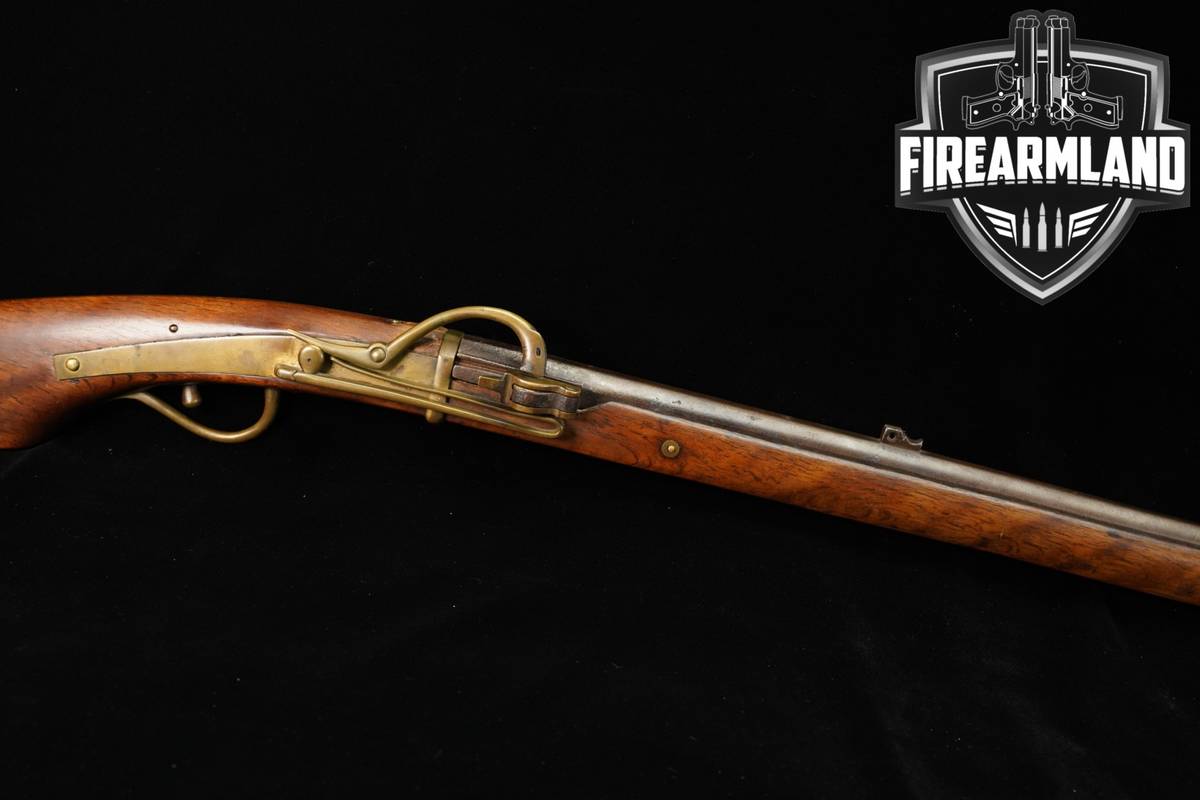
Japanese Edo Period Tanegashima Matchlock Musket, .43 Caliber, 32 in Octagonal Barrel, Mid to Late Edo Era
This mid to late Edo period tanegashima (hinawaju) is a small-bore Japanese matchlock musket notable for its 32 in octagonal barrel with a flared muzzle collar, sliding iron/steel pan cover, and brass serpentine with arched guard. Built in Japan and classified at approximately 2.5–3 monme (.43 caliber/11 mm), it was most likely made as a Samurai Guard gun or a martial arts school practice rifle. The full-length hardwood stock features distinctive brass- or bronze-lined apertures and an inome (heart-shaped) pierced plate. No maker's signature or crest is observed.
Condition
Overall Condition: Good condition, showing some signs of prior use and handling.
Bore Condition: Good - Clean, well-maintained, minor wear marks.
Specific Condition Notes: The barrel shows a dark plum-brown patina that is largely free of active red rust. The stock has multiple hairline cracks. Overall, the musket appears to have been maintained well for its age.
What’s Included
- Japanese Edo-period tanegashima matchlock musket
- Wooden ramrod
This Edo-period hinawaju represents Japan's classic matchlock form with a small-bore class of approximately 2.5–3 monme (.43 caliber/11 mm). It was most likely produced for Samurai guard duties or martial arts school practice, aligning with its bore size and traditional configuration.
The iron/steel barrel measures 32 in, is octagonal, and ends in a flared muzzle collar. Sighting is straightforward, with a fixed front bead at the muzzle and a simple fixed rear sight block. The barrel is secured to the stock with traditional mekugi pins.
The lockwork follows established Japanese matchlock design, featuring a brass serpentine and an arched guard. A sliding iron/steel pan cover accompanies the priming pan, reflecting period construction and practical protection for the priming charge.
The full-length hardwood stock shows the deeply dropped butt characteristic of the type, along with a small brass heel cap. Notable decorative and functional elements include a row of brass- or bronze-lined apertures in the buttstock and an inome (heart-shaped) pierced plate. A wooden ramrod rides in the ramrod channel. No maker's signature or crest is observed.