
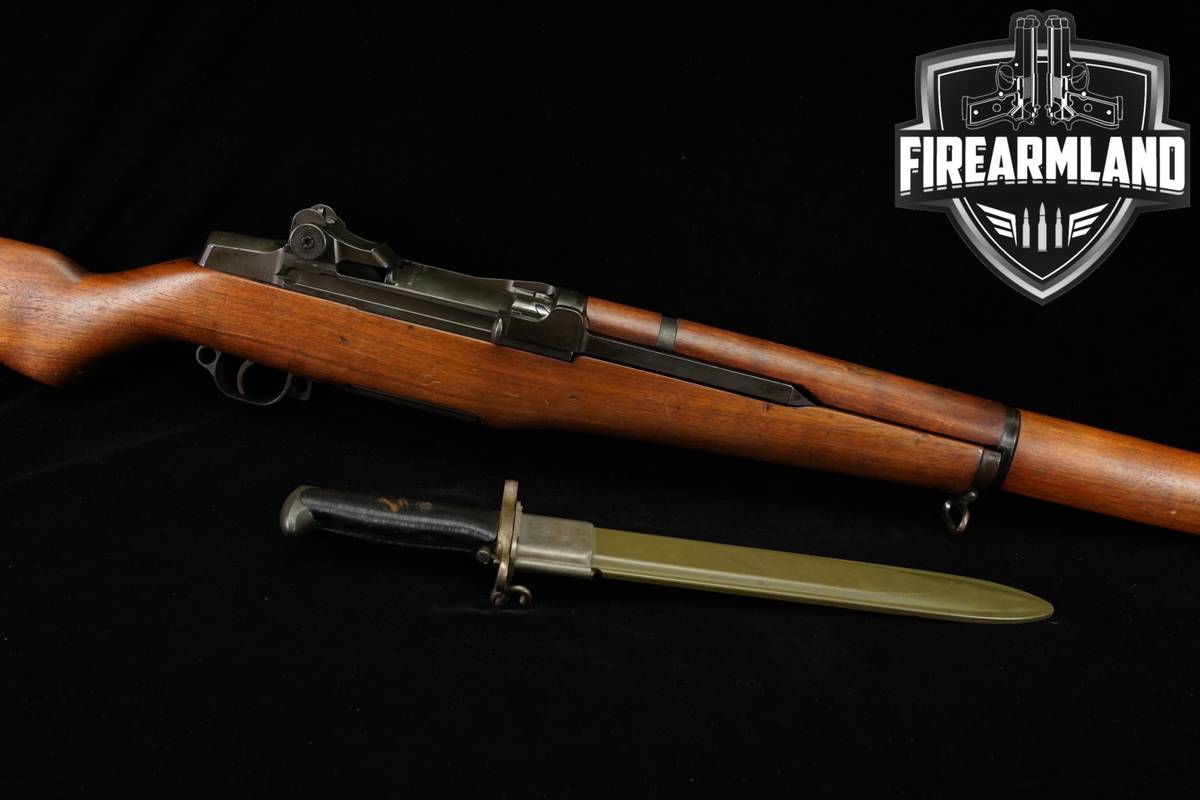
Springfield Armory M1 Garand .30-06, Post-War (1952–1954), 24-inch Barrel, Parkerized Finish, Walnut Stock
This Springfield Armory M1 Garand is a post-war .30-06 rifle with a 24-inch barrel, Parkerized finish, and walnut stock and handguards. The receiver serial falls within the Springfield 4.2–4.4 million block, dating it to 1952–1954. It features the classic 8-round internal en-bloc clip system, aperture sights with windage and elevation knobs, and an excellent, mirror-bright bore. It also includes a U.S. M1 bayonet with M7 scabbard and M1 Garand en-bloc clips.
Condition
Overall Condition: Very good condition, showing only light, superficial signs of prior handling or use.
Bore Overall Condition: Excellent - Clean, mirror finish, no signs of wear.
Bore Rifling: Excellent Rifling - Sharp lands and grooves.
Specific Condition Notes: Light scratches and blemishes are present on the metal and wood. The finish shows an even patina. Small, localized spots of pitting are noted.
What’s Included
- U.S. M1 bayonet with M7 scabbard
- M1 Garand en-bloc clips
Built on the M1 platform, this rifle uses a semi-automatic, gas-operated, long-stroke piston system with a rotating bolt. Feeding is via the standard 8-round internal en-bloc clip, consistent with service-issue configuration.
The rifle retains a Parkerized steel receiver and components, paired with walnut furniture. The stock features a checkered steel buttplate with trapdoor and two-piece walnut handguards. A circled "P" firing proof is stamped on the pistol grip.
Sighting is via an aperture rear sight with windage and elevation knobs and a protected front post. A bayonet lug is integral to the gas cylinder, with the stacking swivel mounted on the gas cylinder and the front sling swivel on the lower band/stock ferrule just behind the gas cylinder; both are present. The gas cylinder lock screw has the central recessed/ported pattern.
The 24-inch barrel, 13-inch length of pull, and robust service configuration reflect the post-war Springfield Armory production period (1952–1954). The receiver falls within the 4.2–4.4 million block, aligning it with this era of U.S. manufacture.