
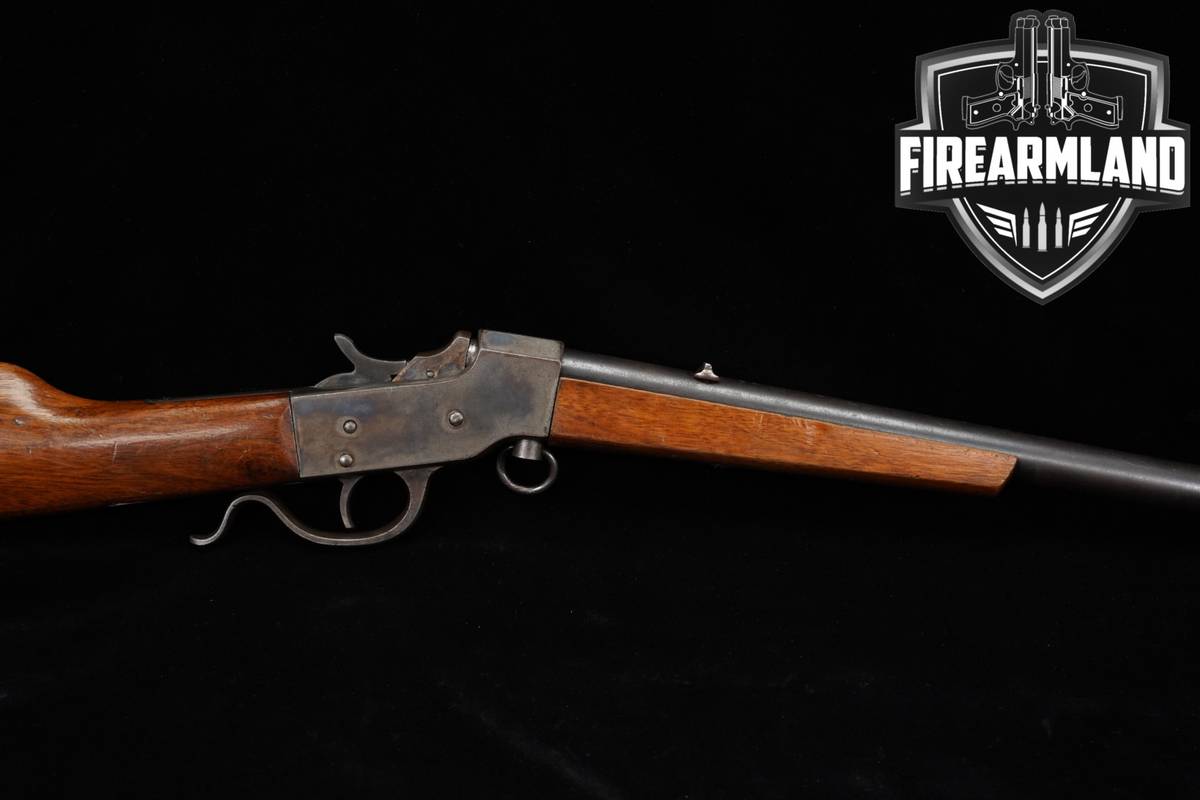
Hopkins & Allen No. 822 .22 LR Single-Shot Boys' Rifle, Lever-Operated Rolling-Block, 21.25 in Barrel, Early 1900s
This Hopkins & Allen No. 822 is a .22 LR single-shot boys' rifle from the early 1900s, built on a lever-operated rolling-block action with an external hammer and a color case-hardened receiver. It features a measured 21.25-inch round, tapered barrel and classic iron sights. Barrel-top markings in the later "Arms Co., Norwich, Conn., U.S.A." style indicate post-1896 production within Hopkins & Allen's 800-series.
Condition
Overall Condition: Fair condition, showing extensive signs of prior use and handling.
Bore Overall Condition: Poor - Noticeable dirt, stains, significant corrosion or damage.
Bore Rifling: Poor Rifling - Rifling heavily worn or filled with fouling or debris.
Specific Condition Notes: There is a bulge in the barrel approximately 9.5 inches from the muzzle. The metal shows widespread finish wear and patina. The wood stock and forend have visible scratches.
What’s Included
- Hopkins & Allen No. 822 single-shot rifle
The action uses a lever integrated with the trigger guard to rotate the breechblock open, with a visible extractor for easy single-round loading and ejection. An external hammer with a checkered spur provides positive control. Chambered in .22 LR with a 1-round capacity, it follows the straightforward, reliable operation expected of the 800-series design.
The barrel measures 21.25 inches and has a round, tapered profile suited to the lightweight boys' rifle format. Sighting is via a fixed, dovetailed front blade and a barrel-mounted open rear notch, keeping the sight picture simple and familiar.
The stock is wood with a straight grip and an uncheckered finish, paired with a slim forend that has a rounded tip. The length of pull measures 13.25 inches, consistent with the compact youth-oriented configuration.
The receiver shows a color case-hardened finish, and the top of the barrel is stamped "THE HOPKINS & ALLEN ARMS CO NORWICH, CONN. U.S.A." alongside "No. 822." This later marking format aligns with post-1896 production. A ring-shaped stud is present under the forward portion of the receiver.