
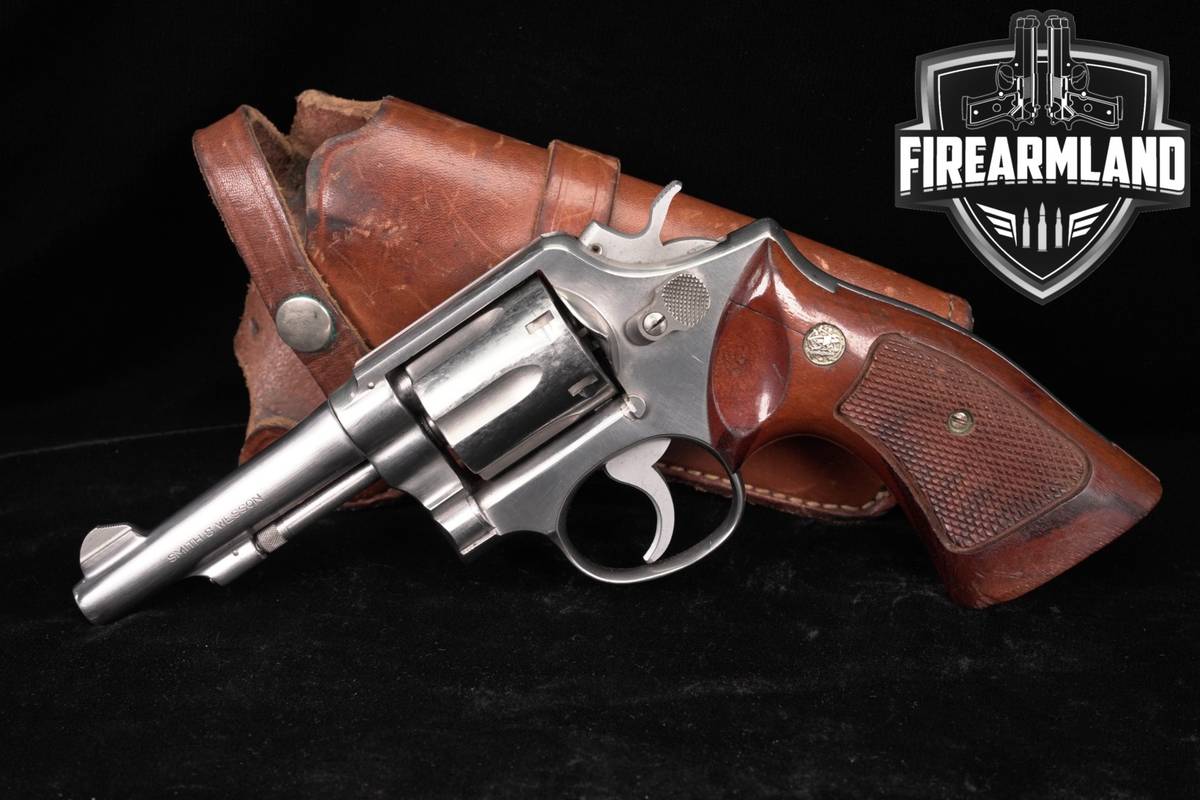
Smith & Wesson Model 64 No-Dash .38 Special, 4-inch Pinned Tapered Barrel, Stainless K-Frame, 6-Shot DA/SA
This early Smith & Wesson Model 64 no-dash is the stainless K-frame counterpart to the Model 10, built as a six-shot, fixed-sight service revolver. It features a 4-inch pinned, tapered stainless barrel, brushed stainless finish, and checkered walnut stocks with S&W medallions. Pre-MIM construction, no internal lock, and a D-prefix serial range place this example in the 1973–1974 production window.
Condition
Overall Condition: Good condition, showing some signs of prior use and handling.
Bore Condition: Excellent - Clean, mirror finish, no signs of wear.
Rifling: Excellent - Sharp lands and grooves.
Specific Condition Notes: There are markings from previous handling and use. Please refer to the photos for a detailed view of the cosmetic condition.
What’s Included
- Brown leather duty belt holster with thumb-break retention strap
The Model 64 no-dash is a straightforward, duty-grade revolver built on S&W's K-frame with fixed sights and a six-shot 6-flute cylinder. As the stainless counterpart to the Model 10, it offers corrosion-resistant construction with service-ready features and controls.
This example has the early no-dash configuration with a 4-inch tapered barrel that is factory pinned. Sights are fixed, with a serrated ramp front and a rear notch cut into the grooved topstrap for a clean, snag-resistant sight picture.
The action is double-action/single-action with an exposed hammer and a smooth-faced, narrow trigger. It uses the standard S&W push-forward cylinder latch, plus a knurled ejector-rod tip and a short front ejector-rod lug for positive extraction.
Construction is all stainless steel, including the frame, barrel, and cylinder, with a brushed stainless finish. Original-style checkered walnut stocks with S&W medallions complement the service configuration.
Made in the United States in the early 1970s (1973–1974), this revolver falls in the D-prefix serial range and retains the desirable pre-MIM, no internal lock configuration associated with that era.