
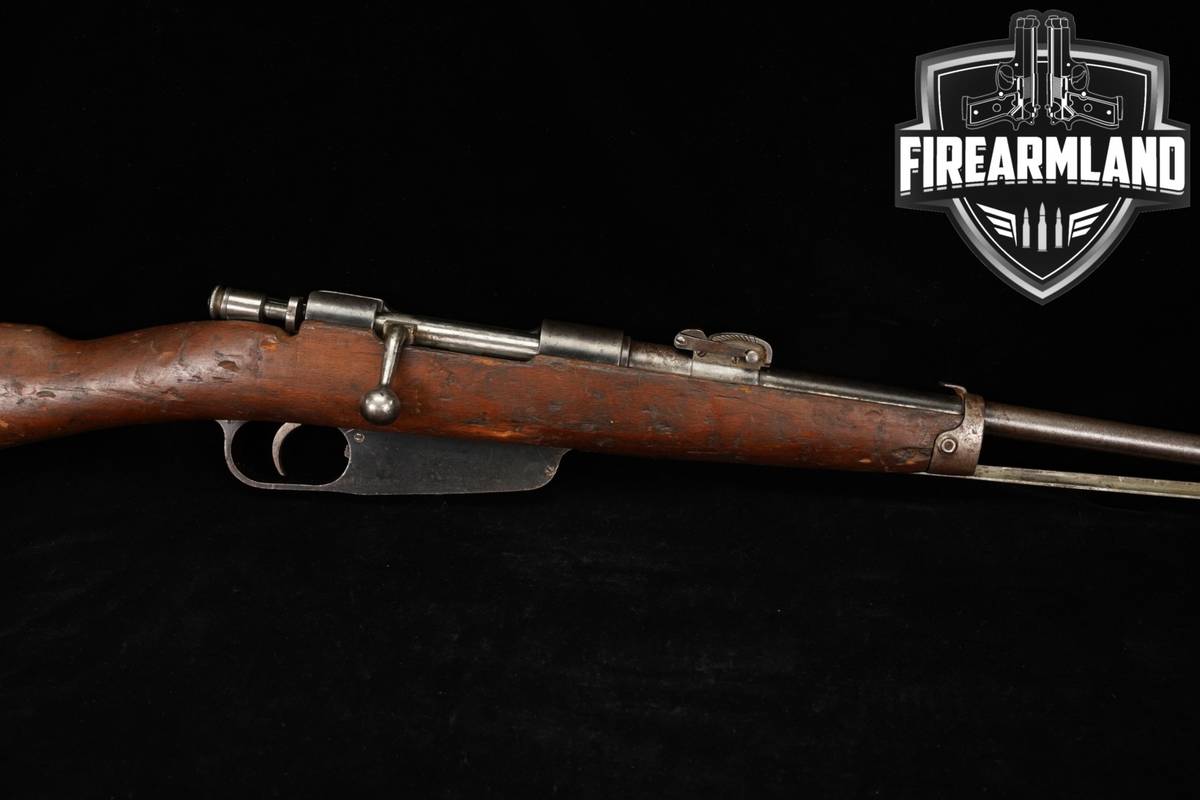
Brescia Moschetto Mod. 91/38 da Cavalleria 6.5 Carcano, 17.7 in Barrel, Folding Bayonet, 1938 Italian Cavalry Carbine
This Italian Moschetto Mod. 91/38 da Cavalleria stands out as a cavalry-pattern Carcano carbine built at Brescia Arsenal in 1938, marked with the dual date "XVI-38" signifying manufacture during the 16th year of the Fascist era. It features the integral folding triangular spike bayonet, the left-side sling bar, and the no-top-handguard configuration that define this model.
Condition
Overall Condition: Fair condition, showing extensive signs of prior use and handling.
Bore Condition: Fair - Generally clean, some residue or smudges, slight corrosion.
Rifling: Fair Rifling - Worn rifling, slight loss of definition.
Specific Condition Notes: There are various gouges, scratches, handling marks, and pitting throughout the firearm.
What's Included
- Brescia Arsenal Moschetto Mod. 91/38 da Cavalleria rifle with integral folding triangular spike bayonet
Made in Italy at the Brescia Arsenal, this compact cavalry carbine uses the 6-round Mannlicher en-bloc clip system in 6.5 Carcano. Its 17.7 in barrel, turned-down bolt handle, and rotating bolt safety align with the M91/38 pattern tailored to mounted and field use.
Key martial markings include "N.A. BRESCIA" and a crowned "RE," along with the "XVI-38" dual-date on the barrel shank. Legal import markings of "ITALY" and "6.5" are present. These verifiable marks help place the rifle within late-1930s Italian production.
The rifle retains the integral folding triangular spike bayonet, a hallmark feature of the da Cavalleria variant, and a left-side sling bar specific to the cavalry configuration. The right fore-end has the bayonet channel, and the stock is hardwood with a steel buttplate.
Sighting is via iron sights with an adjustable tangent/ladder rear sight. The receiver is steel, and the configuration omits a top handguard, consistent with this carbine type.
Notably, the dual-date "XVI-38" denotes manufacture in 1938, during the 16th year of the Fascist era, underscoring its production context and period-correct features.