
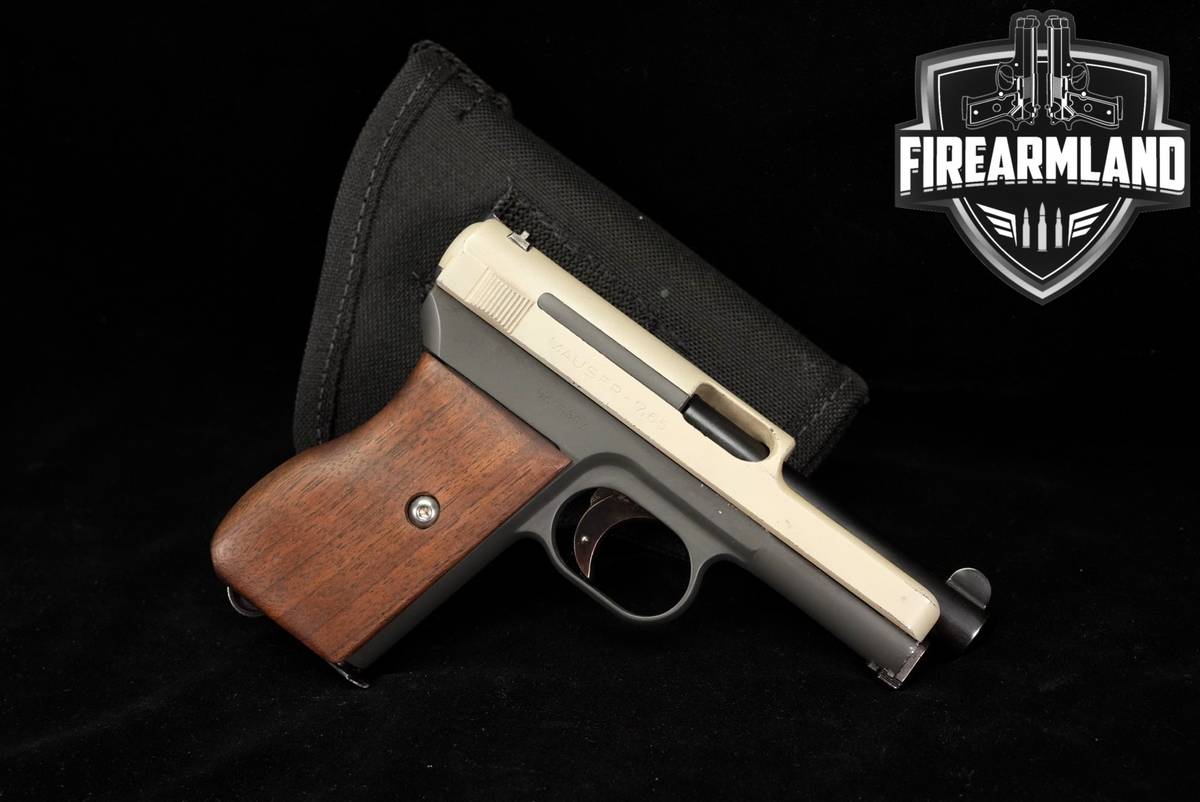
Mauser Model 1914 .32 ACP Weimar-Era German Compact Pistol, 3.14 in Barrel, 8+1, Two-Tone, Export-Marked
This Weimar-era Mauser Model 1914 is a commercial/export example from 1927–1928 chambered in .32 ACP (7.65mm Browning). It features a compact fixed-barrel blowback design, a two-tone finish, and a Germany export stamp. Notable details include the Mauser banner cartouche on the left frame, a lanyard ring at the heel, and serial numbers present on the slide and frame.
Condition
Overall Condition: Fair condition, showing extensive signs of prior use and handling.
Bore Condition: Good - Clean, well-maintained, minor wear marks.
Bore Rifling: Good Rifling - Intact, well-defined lands and grooves.
Specific Condition Notes: There are chips on the lower frame and around the trigger well. The slide closes when the slide is locked to the rear and the magazine is removed. Normally, this model will drop the slide when a magazine is inserted; on this example the slide does not drop when a magazine is inserted, only when it is removed. The pistol will need gunsmithing to restore full functionality.
What’s Included
- 1x 8-round steel single-stack magazine
- Brauer Bros Mfg clip-on holster
Built during the Weimar era and export-marked for commercial sale, this Model 1914 reflects Mauser’s interwar production with German export stampings and the Mauser banner cartouche on the frame. The slide and frame both carry serial markings.
Its compact size, 3.14 in fixed barrel, and 8+1 capacity in .32 ACP make it a classic pocket pistol format. The design is a striker-fired, fixed-barrel blowback system with the slide serving as a top cover.
Construction is all steel with smooth wood grip panels, a manual safety, and fixed sights comprising a small front blade and a rear notch. Vertical rear serrations and an open-top ejection port aid manipulation and ejection, while a lanyard ring at the heel adds a practical carry feature.
The exterior shows a two-tone finish. As designed for this model, the slide locks open on an empty magazine and is typically intended to close when a loaded magazine is inserted.