
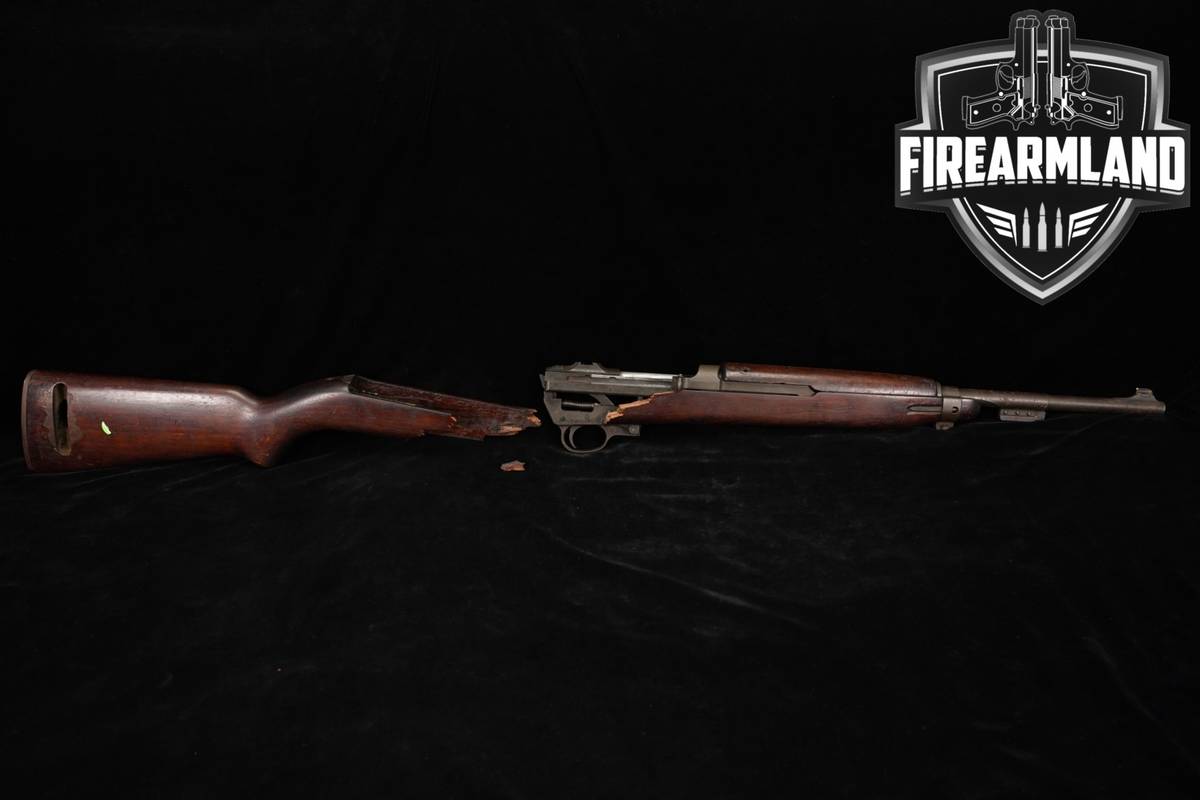
Inland Division (GM) M1 Carbine .30 Carbine Semi-Auto Rifle, WWII-Era Mixed-Parts Configuration, 18-Inch Barrel, Parkerized
This Inland Division of General Motors M1 Carbine is a WWII-era U.S.-made service rifle with an 18-inch barrel, GI phosphate/Parkerized finish, and military hardwood stock. It features a Type I narrow barrel band stamped "SI," a round bolt, and a stamped sheet-metal trigger housing. The bore is bright and clean with well-defined rifling, and the receiver retains the dovetail for the rear sight, which is not installed.
Condition
Overall Condition: Poor condition.
Bore Overall Condition: Good - Clean, well-maintained, minor wear marks.
Bore Rifling: Good Rifling - Intact, well-defined lands and grooves.
Specific Condition Notes: The wooden stock is broken and will need replacement. The carbine is not in functional condition in its current state. The rear sight is not installed. There are handling marks and areas of rust from previous use. No magazine is included.
What's Included
- Inland Division of General Motors M1 Carbine rifle, .30 Carbine, as described
The receiver serial (6,672,861) indicates Inland production in mid-1945; however, this carbine is a mixed-parts example rather than a factory-correct mid-1945 configuration. The markings include "INLAND DIV." and "U.S. CARBINE CAL. .30 M1" on the receiver, reinforcing its WWII U.S. production origin.
The rifle wears earlier-type hardware, including a Type I narrow barrel band without a bayonet lug, stamped "SI." It is fitted with a protected front sight. The receiver has the standard dovetail for the rear sight, but the rear sight itself is not installed. A mid-1945 Inland would typically have a Type III band with bayonet lug and an adjustable rear sight.
Key Inland features are present, including the round bolt profile and a stamped sheet-metal trigger housing. The GI phosphate/Parkerized finish remains consistent with wartime production. The military hardwood stock has the early I-cut/rectangular sling/oiler slot and a checkered steel buttplate; the stock is broken and requires replacement.
Mechanically, the design uses a semi-automatic, short-stroke gas piston with a rotating bolt and a detachable box magazine system. While no magazine is included, the bore is notably bright and clean with well-defined lands and grooves.