
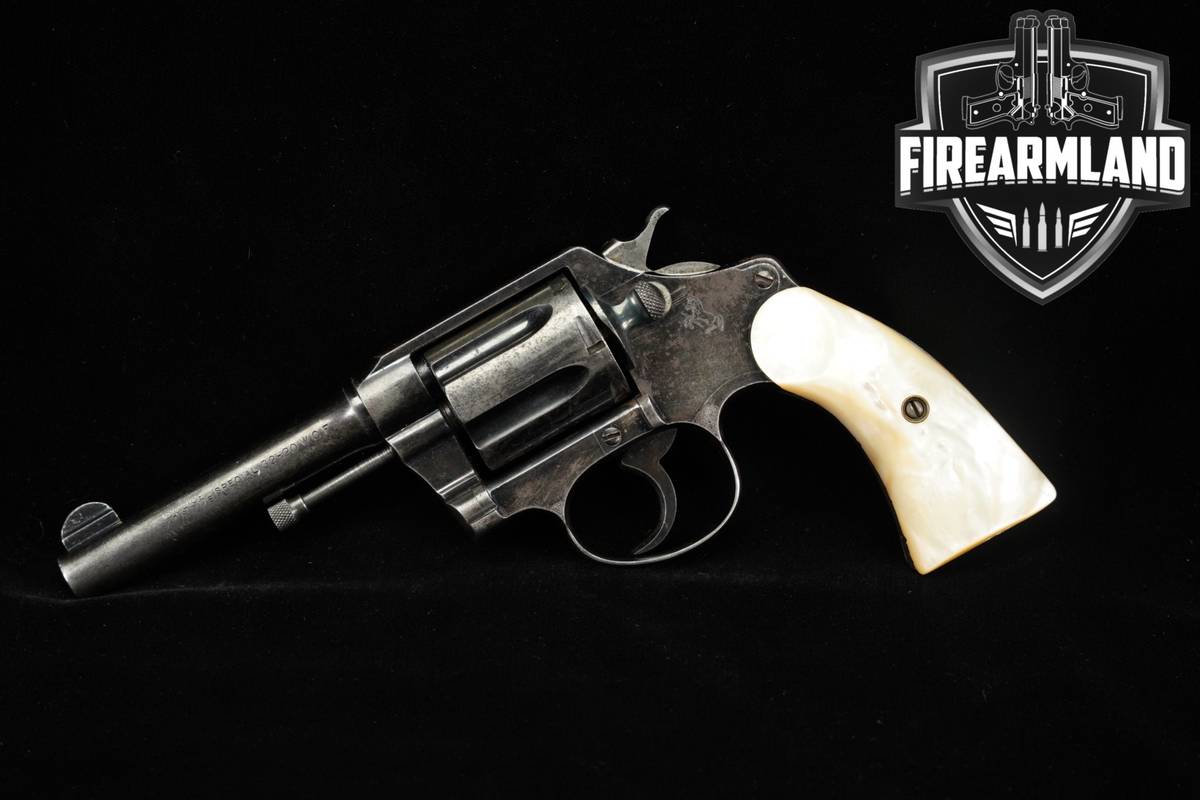
Colt Police Positive Special First Issue .32-20 WCF Revolver, 4-Inch Barrel, 1914, Blued DA/SA
This is a First Issue Colt Police Positive Special manufactured in 1914 and chambered in .32-20 WCF, a less common chambering for this model. It features a 4-inch tapered round barrel without an ejector-rod shroud, a six-shot fluted cylinder, and blued carbon-steel construction. The revolver is fitted with smooth pearl-style aftermarket grip panels and retains classic fixed sights.
Condition
Overall Condition: Fair condition, showing extensive signs of prior use and handling.
Bore Condition: Good - Clean, well-maintained, minor wear marks.
Bore Rifling: Good Rifling - Intact, well-defined lands and grooves.
Specific Condition Notes: Lockup is tight and the action is smooth. There is widespread finish wear and scratching. There are widespread patches of pitting on metal surfaces. The bore shows visible blemishes, though rifling is present.
What’s Included
- Colt Police Positive Special First Issue revolver (.32-20 WCF, 4-inch barrel, 1914)
- Aftermarket smooth pearl-style grip panels (installed; no Colt medallions)
The Police Positive Special First Issue profile is evident in its 4-inch tapered round barrel and square-butt grip frame. The six-shot, fluted cylinder uses a swing-out star ejector with a knurled ejector-rod tip, and there is no ejector-rod shroud, consistent with early production features.
Chambered in .32-20 WCF (also marked as .32-20 W.C.F. on the barrel), this example reflects a less common chambering for the model. The barrel carries the factory legend "POLICE POSITIVE SPECIAL 32-20 W.C.F," a two-line Colt address and patent legend on top, and the Colt rampant horse logo appears on the right sideplate.
The revolver operates in double action/single action and incorporates Colt's Positive Lock internal safety. Sight picture is provided by a fixed half-moon front sight and a fixed topstrap notch rear sight.
This revolver wears smooth pearl-style aftermarket grip panels without Colt medallions. An inspector/assembly stamp "K" with numeral is present on the crane cut, aligning with factory assembly practices of the period.