
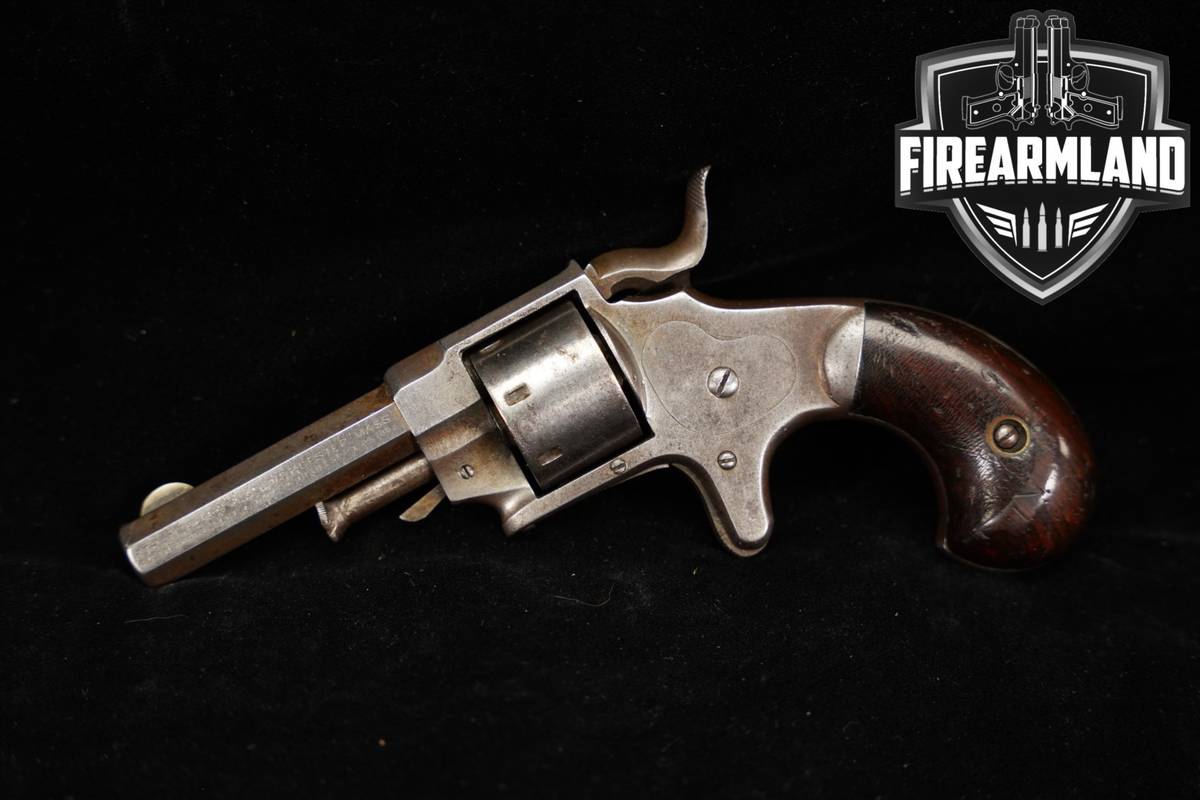
Ethan Allen Sidehammer .22 Rimfire Eighth Issue Revolver, .22 Short, 7-Shot, 2.25" Octagonal Barrel, Antique
This Ethan Allen Sidehammer .22 Rimfire Eighth Issue is an early American pocket revolver produced circa the late 1850s to mid 1860s, with an estimated run of roughly 1,000–1,500 units. Identified by its birds-head grips, side-mounted hammer, and spur trigger, it is a scarce .22 Short, seven-shot design with a compact 2.25" octagonal barrel. The Worcester, Mass barrel address remains legible, adding to its appeal for collectors of 19th-century rimfire handguns.
Condition
Overall Condition: Good condition, showing some signs of prior use and handling.
Bore Condition: Fair - Generally clean, some residue or smudges, slight corrosion.
Bore Rifling: Fair Rifling - Worn rifling, slight loss of definition.
Specific Condition Notes: The revolver presents as solid for its vintage. The metal shows widespread finish pitting and patina with scattered scratches and handling marks. The bore shows significant blemishing throughout.
What’s Included
- Ethan Allen Sidehammer .22 Rimfire Eighth Issue revolver
The Eighth Issue is distinguished within the Sidehammer series by its walnut birds-head grips and spur trigger without a guard. This example follows the classic side-hammer layout on the right side with a checkered hammer spur, paired to an iron frame and receiver for a compact, pocketable profile of the period.
It features a 2.25" octagonal barrel and fixed sights, with a front-sight slot at the muzzle and a rear notch integral to the frame/topstrap. A latch plate on the top strap retains the cylinder pin, and an under-barrel sliding ejector rod provides case removal consistent with the design of the era.
The revolver is chambered in .22 Short and uses a seven-shot unfluted cylinder. Operation is single-action only, reflecting the straightforward mechanics of early rimfire pocket revolvers.
Details such as the heart-shaped right-side sideplate and the clearly legible Worcester, Mass barrel address align with known production characteristics. Built in the United States during the late 1850s to mid 1860s, this scarce configuration represents an early American rimfire design with low estimated production, making it a notable collectible example.