
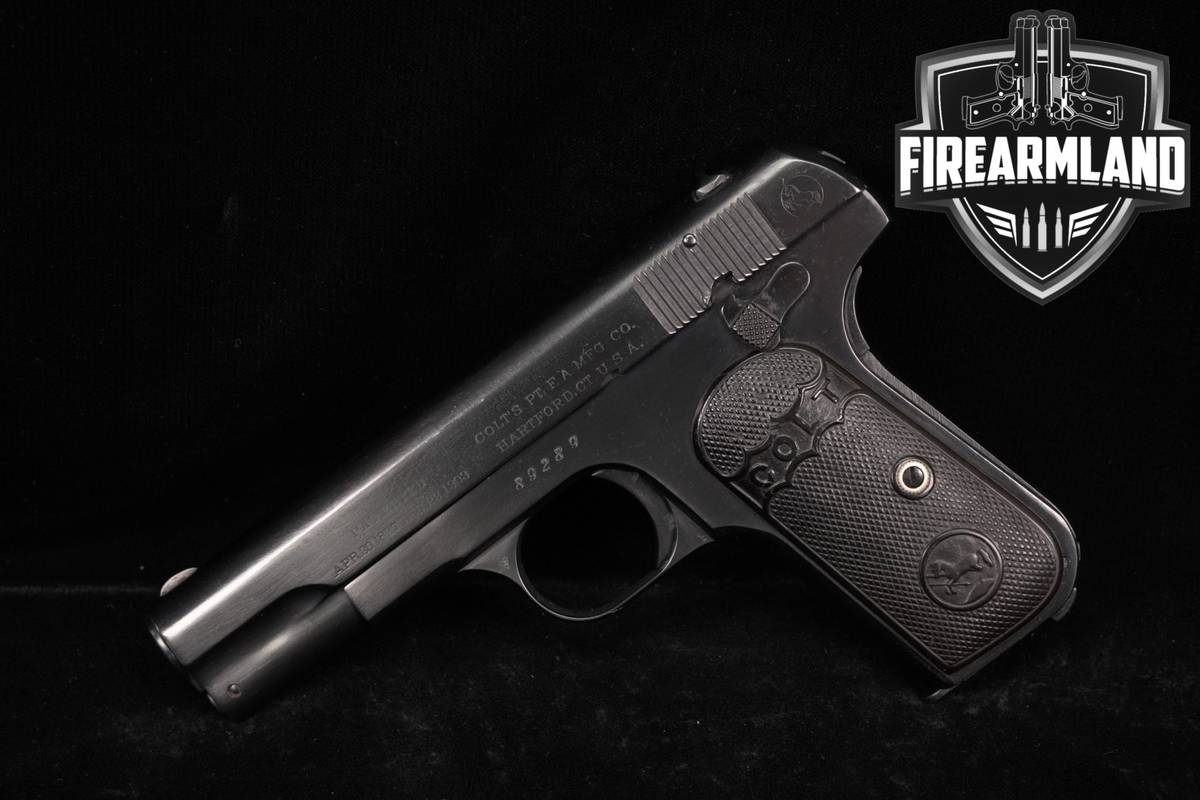
Colt Model 1903 Pocket Hammerless Type II .32 ACP, 1909, Blued, Compact, 3.75 in Barrel
This 1909 Colt Model 1903 Pocket Hammerless is a Type II variant with the short 3.75 in barrel pattern and early slide legends. It features a blued steel construction, checkered Colt hard rubber grips, and the classic internal-hammer, single-action, straight-blowback system. As an early production example from the 1908–1910 Type II period, it combines compact dimensions with hallmark Colt markings and Browning design elements.
Condition
Overall Condition: Good condition, showing some signs of prior use and handling.
Bore Overall Condition: Good - Clean, well-maintained, minor wear marks.
Bore Rifling: Good Rifling - Intact, well-defined lands and grooves.
Specific Condition Notes: The bore is in good condition. As a 1909 Type II example, the pistol presents as reasonably good for its age.
What's Included
- 1x 8-round detachable single-stack steel magazine with witness holes
Type II examples are defined by the short 3.75 in barrel and early marking pattern. This pistol retains those early legends: "PATENTED APR. 20, 1897 DEC. 22, 1903" and "AUTOMATIC COLT CALIBRE .32 RIMLESS SMOKELESS," with the Colt rampant horse rollmark behind the rear serrations. Overall length is approximately 6.75 in, giving it a compact footprint.
The slide features vertical rear serrations, a right-side ejection port, and a disassembly/hold-open notch. Fixed sights include a half-moon front and a rear notch, consistent with period configuration and intended concealability.
Operation is single-action with a straight-blowback system and an internal hammer. Controls include a manual thumb safety, a grip safety, and a heel-release for the single-stack magazine. The included magazine has witness holes, as expected for this model.
Construction is blued steel throughout, paired with checkered hard rubber grips bearing the "COLT" ribbon and rampant colt medallion. Designed with Browning’s rotating barrel-groove takedown method, the Model 1903 later saw U.S. General Officers issue, underscoring the design’s standing in service and history. Made in the United States, this 1909 Type II falls squarely within the 1908–1910 production window that enthusiasts track in the 1903’s evolution.