
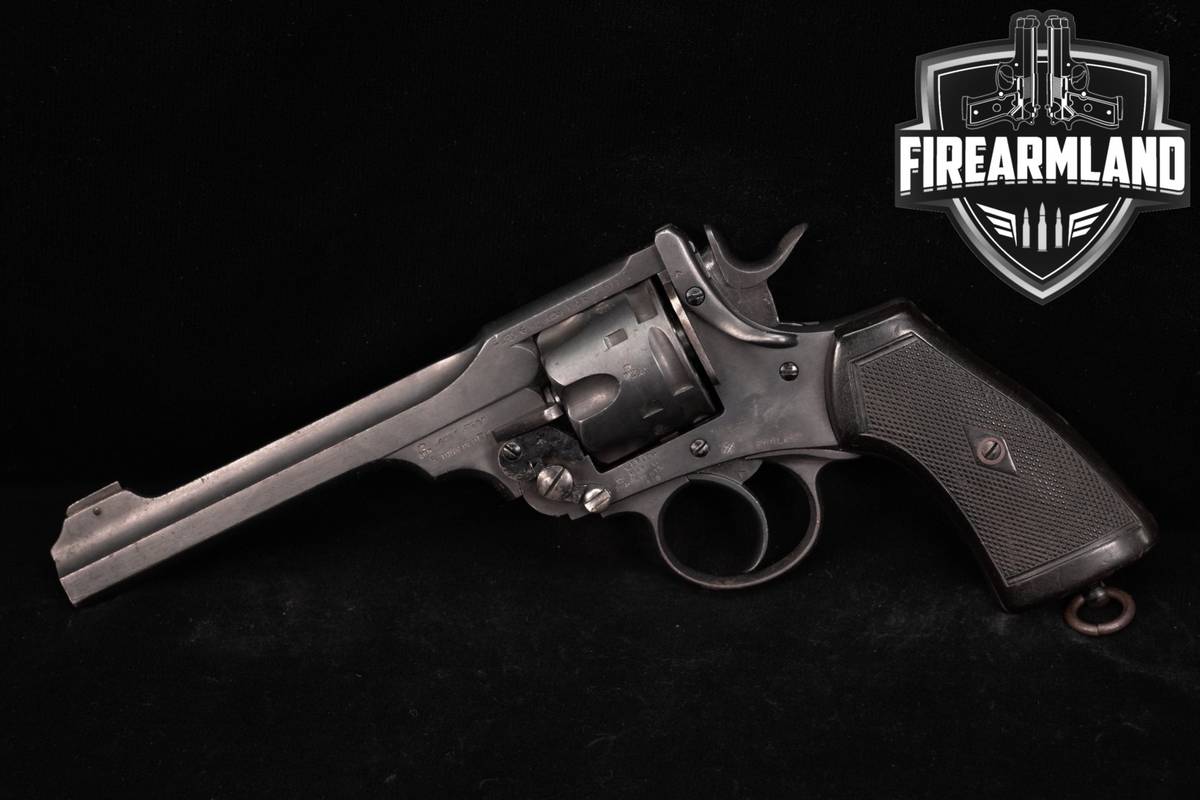
Webley & Scott Mark VI .45 ACP Top-Break Revolver, 6 Inch, 1918, WWI-Era, Blued, DA/SA
This 1918 Webley & Scott Mark VI is a World War I–era top-break revolver with its hallmark stirrup latch and simultaneous-ejector star. It has been converted to .45 ACP, a common and practical update, with a shaved cylinder. The revolver retains its 6-inch barrel with integral rib, blued finish, fixed sights, and checkered hard rubber grips, along with clear British proof and inspection markings.
Condition
Overall Condition: Good condition, showing some signs of prior use and handling.
Bore Condition: Good - Clean, well-maintained, minor wear marks.
Bore Rifling: Good Rifling - Intact, well-defined lands and grooves.
Specific Condition Notes: The revolver shows scattered scratches and blemishes with isolated spots of pitting in the finish. It appears to have been converted to .45 ACP; the cylinder has been shaved slightly, removing the bottom portion of the cylinder serialization.
What’s Included
- Webley & Scott Mark VI top-break revolver (converted to .45 ACP)
Built in 1918, this Mark VI captures the definitive service configuration: a robust carbon-steel frame and 6-inch barrel with an integral rib, paired with fixed sights consisting of a square, screw-retained front blade and a topstrap notch at the rear. The DA/SA action and spurred hammer complete the classic service layout.
The top-break design with stirrup latch and simultaneous-ejector star enables fast, unified extraction of all six chambers. The fluted, six-shot cylinder complements the revolver’s full-size profile, and a lanyard ring on the butt reflects its military service intent.
British military and commercial markings remain a highlight. Notable stamps include Crown over BNP Birmingham Nitro Proofs on the frame and cylinder, British broad arrow and inspection marks, and the proof/caliber line reading ".455" .760" 6 TONS PER [square]." Factory markings include "MARK 'VI'" on the topstrap and "WEBLEY MARK VI PATENTS 1918" on the frame.
This example has been converted to .45 ACP, a common modification for the model. The conversion involved shaving the cylinder, which removed the bottom portion of the cylinder serialization. The bore condition and rifling present well for a revolver of this era, supporting its practical shootability alongside its historic appeal.
Materials and finish are consistent throughout: carbon-steel frame and barrel with a blued finish, and a blued steel cylinder. The original-style checkered hard rubber (vulcanite) grip panels with diamond escutcheons provide a correct period look and secure purchase.