
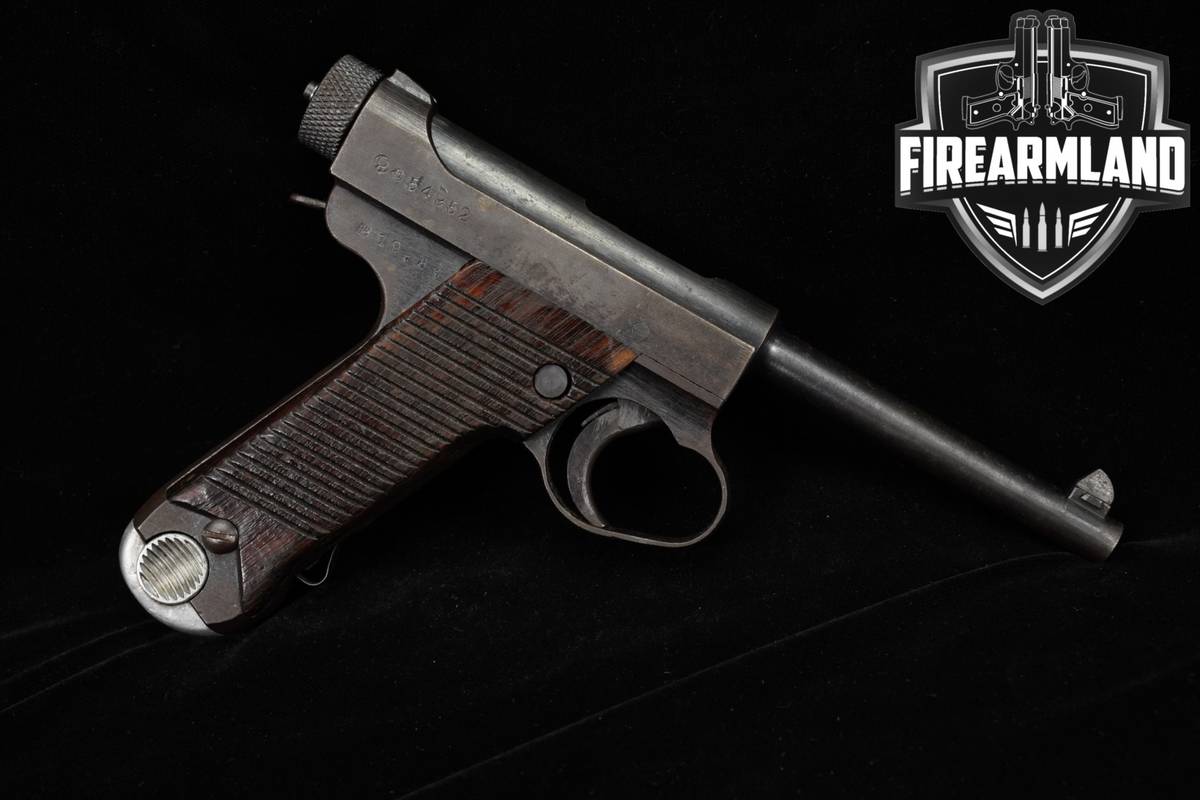
Chuo Kyogo Type 14 Nambu Late-Pattern 8x22mm Pistol, 4.6 in Barrel, 1944 (Showa 19.6)
This late-pattern Type 14 Nambu was manufactured by Chuo Kyogo in June 1944, as indicated by the Imperial date code "昭 19.6." It features the enlarged winter trigger guard and standard wartime markings, including the kanji model designation "十四年式." A widely issued WWII Japanese service sidearm, this example is in very good overall condition with a clean, shiny bore.
Condition
Overall Condition: Very good condition, showing only light, superficial signs of prior handling or use.
Bore Condition: Good - Clean, well-maintained, minor wear marks.
Bore Rifling: Good Rifling - Intact, well-defined lands and grooves.
Specific Condition Notes: This firearm is in solid shape. It shows scattered cosmetic imperfections, including scratches, minor blemishes, and areas of finish loss. The bore remains clean and shiny.
What’s Included
- 1 single-stack Type 14 Nambu 8-round magazine with aluminum base and concentric-groove finger disc
This is a late-pattern Type 14 with the enlarged winter trigger guard, a feature adopted to improve gloved-hand access. The right side of the frame carries the Imperial date code "昭 19.6," corresponding to June 1944, and the right receiver is marked with the model kanji "十四年式."
Manufactured by Chuo Kyogo (Chūō Kōgyō), this WWII-era service pistol uses a striker-fired, locked-breech system with a vertically moving locking block. A knurled rear cocking knob/bolt cap with a visible firing-pin tip is characteristic of the design.
Controls are straightforward and period-correct: a single-action trigger, a manual safety, and a heel-style magazine release. Fixed sights consist of a front blade and a rear notch for a clean, durable sight picture.
The pistol is full-size with steel construction throughout the barrel and receiver. It retains wood grip panels with full-length horizontal serrations, providing a secure hold and matching the late-war configuration.
The included Type 14 single-stack magazine has the aluminum base with a concentric finger disc typical of the pattern, aligning with late-war Japanese production features.