
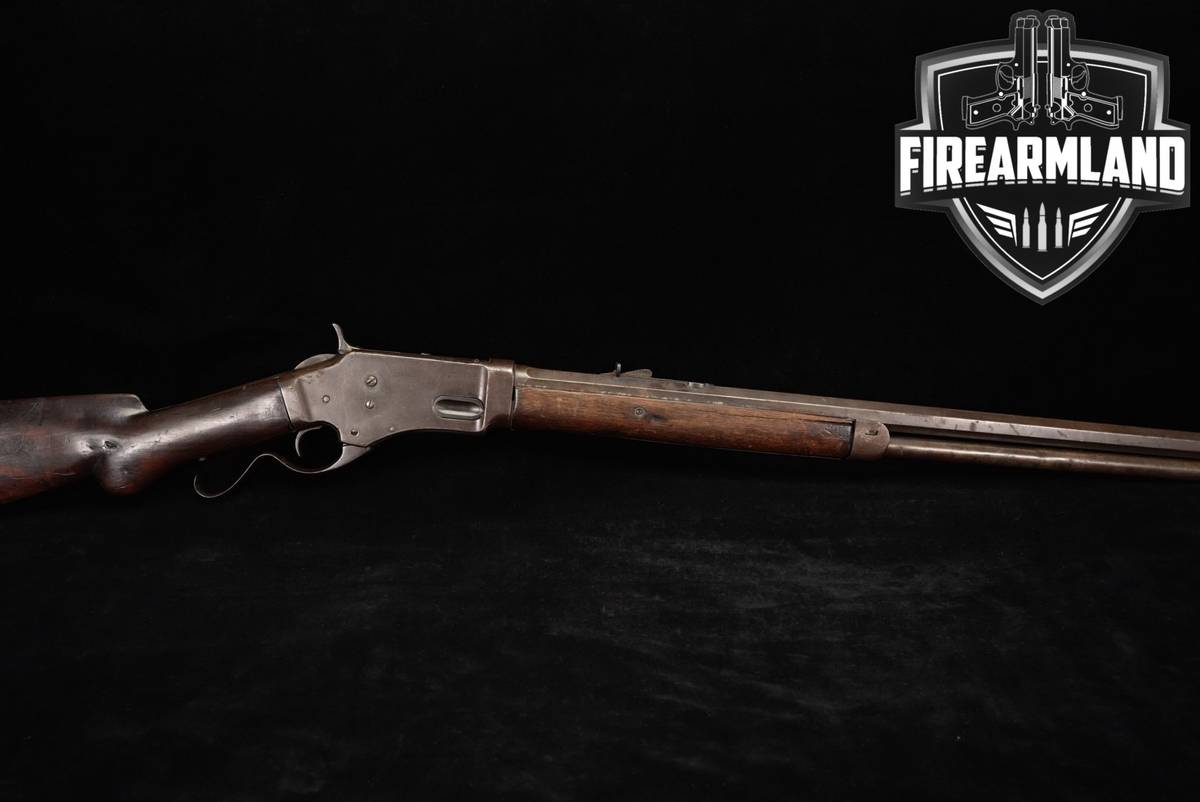
Whitney-Burgess-Morse Model 1878 Sporting Rifle, .45-70 Govt., 28 in Octagon Barrel, Lever-Action Repeater
This rare, antique Whitney-Burgess-Morse Model 1878 Sporting Rifle stands out for its short production run circa 1878–1882 and its role in the U.S. military repeating-rifle trials of 1878. It features a large-frame lever-action design with an under-barrel tubular magazine, a 28 inch octagon barrel marked "45 CAL 70GR. C.F.", and patent markings for G. W.
Morse and A. Burgess. The configuration and markings make it a notable example for advanced collectors of early American repeaters.
Condition
Overall Condition: Fair condition, showing extensive signs of prior use and handling.
Bore Overall Condition: Good - Clean, well-maintained, minor wear marks.
Bore Rifling: Good Rifling - Intact, well-defined lands and grooves.
The rifle is structurally solid for its vintage and rarity. The forend (forearm) is cracked in several places and fits loosely. The stock shows visible blemishes and cracks. Metal surfaces display widespread patina and pitting, with extensive scratching and surface wear. The lever exhibits very loose movement during operation.
The rifling is present but shows extensive blemishing.
What's Included
- Whitney-Burgess-Morse Model 1878 Sporting Rifle
The Whitney-Burgess-Morse is a large-frame lever-action repeater built in the United States with a short, low-volume production run around 1878–1882. This example bears the top-flat/tang patent markings for G. W. Morse (Oct. 28, 1856) and A.
Burgess (Jan. 7, 1873; Oct. 19, 1875), reflecting the collaboration behind its early centerfire repeating system and its evaluation in the U.S. military trials of 1878.
Chambered in .45-70 Govt., the rifle has a 28 inch octagon barrel marked "45 CAL 70GR. C.F." Iron sights consist of a dovetailed front blade and a rear barrel sight with a sliding elevator, providing a classic sighting arrangement appropriate to the period.
The action is lever-operated and feeds from an under-barrel tubular magazine with an 8+1 capacity. The receiver is steel, consistent with the robust construction of the design.
Furniture includes a straight-wrist, uncheckered wood stock and a crescent steel buttplate with a trapdoor. Length of pull measures 13.0 inches, completing a historically correct sporting configuration from this era.