
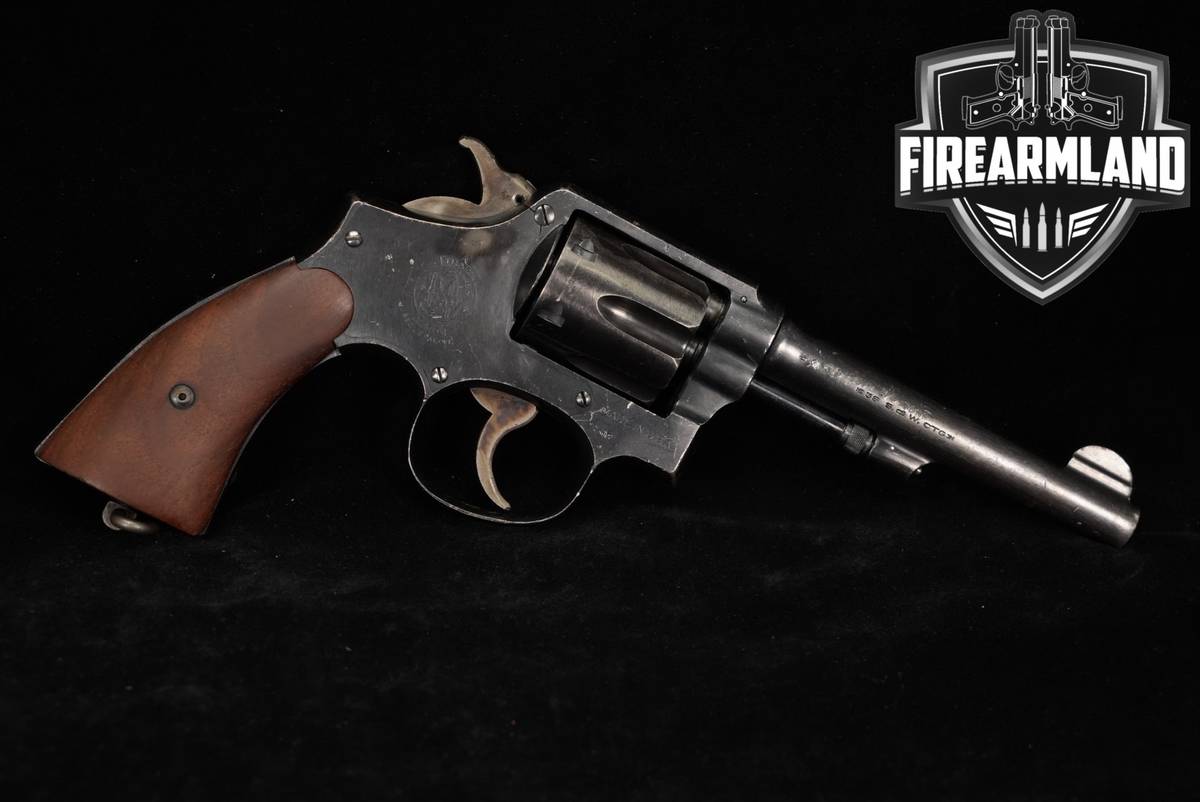
Smith & Wesson .38 Military & Police, Model of 1905 4th Change, 5 in .38 Special, Blued K-Frame, 6-Shot DA/SA
This pre-Model 10 K-frame service revolver is a late pre-Victory era Smith & Wesson .38 Military & Police, Model of 1905, 4th Change, featuring a 5-inch tapered barrel and classic fixed sights. It carries its period-correct features including a non-shrouded ejector rod, round-butt frame with factory lanyard swivel, smooth walnut service stocks, and color case-hardened hammer and trigger. Markings include SMITH & WESSON on the barrel, MADE IN U.S.A. on the frame, and the S&W trademark logo.
Condition
Overall Condition: Good condition, showing some signs of prior use and handling.
Bore Overall Condition: Good - Clean, well-maintained, minor wear marks.
Bore Rifling: Good Rifling - Intact, well-defined lands and grooves.
Specific Condition Notes: This firearm is in solid shape overall. It shows various cosmetic imperfections, including scratches, blemishes, and areas of finish loss. The bore presents bright surfaces.
What’s Included
- Smith & Wesson .38 Military & Police, Model of 1905 4th Change revolver
Built on S&W’s K-frame, this 6-shot fluted-cylinder revolver retains the classic double-action/single-action mechanism and a blued carbon-steel construction throughout. The 5-inch tapered barrel provides a balanced profile and is roll-marked SMITH & WESSON, with caliber markings on the right side.
Its fixed sighting system consists of a half-moon front blade and a rear notch integral to the topstrap, reflecting the service-oriented configuration of the period. The checkered early-style cylinder release latch and non-shrouded ejector rod are correct for this 4th Change iteration.
The round-butt grip frame wears smooth walnut service stocks and a factory lanyard swivel. The hammer and trigger display color case-hardening, adding to the revolver’s authentic pre-war character.
Frame and proof markings include MADE IN U.S.A. and the S&W trademark logo. This example falls in the late pre-Victory serial range that preceded the 1942 V-prefix transition, aligning it with the final pre-war production period.