
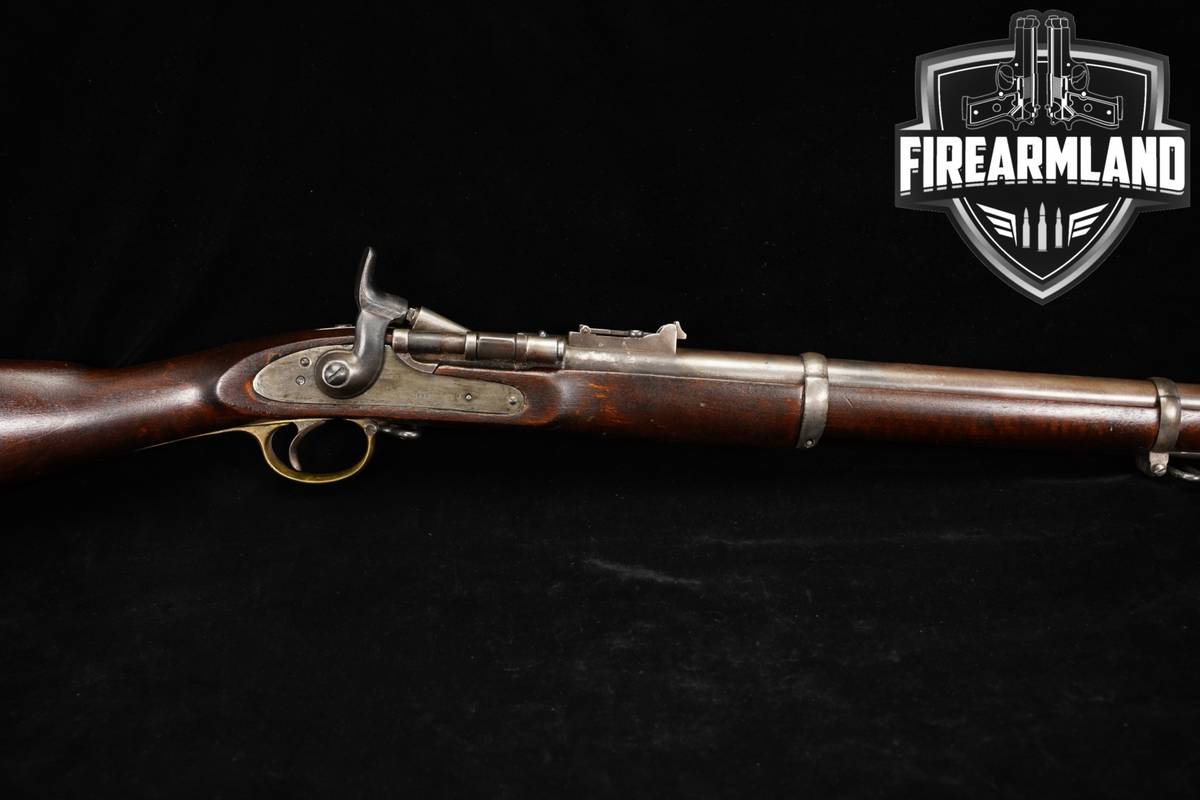
BSA Snider-Enfield Mk II** Artillery Carbine, .577 Snider, 21.25 in Barrel, Antique British Single-Shot
This BSA Snider-Enfield Mk II** Artillery Carbine is a British conversion from a muzzle-loading percussion arm to the .577 Snider breechloading system, produced circa 1867–1869. It features the compact Artillery Carbine configuration with a 21.25 inch barrel, two-band layout, and brass furniture. Clear martial markings, including B.S.A.CO and II**, reinforce its period authenticity and service lineage.
Condition
Overall Condition: Good condition, showing some signs of prior use and handling.
Specific Condition Notes: This is a well-maintained historical example. The walnut stock appears to have been refinished at some point.
Bore Condition: Fair - Generally clean, some residue or smudges, slight corrosion.
Bore Fouling: Moderate Fouling - Lead or copper fouling with noticeable buildup.
Bore Rifling: Fair Rifling - Worn rifling, slight loss of definition.
What’s Included
- Birmingham Small Arms Co. (BSA) Snider-Enfield Mk II** Artillery Carbine chambered in .577 Snider
Originally a muzzle-loading percussion arm, this carbine was converted by Birmingham Small Arms Co. to the .577 Snider system, adopting the signature single-shot breechblock with a top locking latch and extractor. As a Mk II** Artillery Carbine, it pairs compact handling with service-ready features from the late 1860s.
The 21.25 inch iron/steel barrel and two-band layout define the Artillery Carbine configuration. A full-length walnut stock with an oil finish is fitted with brass furniture, including the buttplate, trigger guard, and nosecap. Sling accommodations include a side-mounted bar and ring on the left middle band and bottom sling swivels.
Iron sights consist of a fixed blade front and a carbine ladder/leaf rear sight, with the base marked '100'. Capacity is one round, and operation is via an external hammer and single-shot action.
Period markings are present and informative: B.S.A.CO on the breech shoe, II** on the breech ring, and crown-over-letter inspection/proof marks on the breech and barrel flats. The lockplate is marked TOWER 1863, consistent with an original percussion origin prior to conversion. Additional stamps include the assembly number 702 on the breech hinge and '25 over 78' with a 'B' on the top of the breech block. No buttstock roundel was observed.